front month natural gas price posts the largest one day jump in four years, largest two day price jump on record; US gasoline supplies at a 59 month high with implied gasoline demand at a 3 year low, gasoline production at a 2 year low & gasoline imports at an 11 month low; distillate supplies at a 2 year high
US oil prices finished higher for a fifth consecutive week after France captured a Russian tanker carrying oil across the Mediterranean and Trump warned that an armada of US warships was steaming towards Iran….after inching up 0.5% to $59.44 a barrel last week as threats to Russian and Iranian oil exports outweighed prospects of increased crude supplies from Venezuela, the contract price for the benchmark US light sweet crude for February delivery traded lower on global markets on the US holiday Monday, as fears of supply disruptions eased following reports that the United States had halted plans for potential military action against Iran, and remained subdued in cautious early global trading on Tuesday, amid oversupply worries, as Iran's crackdown on protests had quelled civil unrest, lowering the chance of an attack that could disrupt supplies from the major Middle Eastern producer, but then crept higher early in the last day of trading for that February contract in New York, as traders weighed a messy mix of geopolitics, supply disruptions, and macro tailwinds that all pointed toward higher risk, and settled 90 cents higher at $60.34 a barrel on the temporary suspension of output at Kazakhstan's oil fields, and on expectations of firmer global economic growth that could drive fuel demand, while the more actively traded March contract for US light sweet crude settled $1.02 higher $60.36 a barrel…with markets now citing the the contract price for the benchmark US light sweet crude for March delivery, prices fell in early Asian trading on Wednesday, as traders shifted their focus away from a likely short-lived supply disruption in Kazakhstan and back toward the prospects of rising U.S. inventories and renewed macro uncertainty tied to trade threats, and continued to advance on global markets as escalating geopolitical tensions and renewed trade hostilities from US President Trump unsettled financial markets, prompting traders to reassess risk exposure and energy supply stability, and settled the New York session 26 cents, or 0.4% higher at $60.62 a barrel on the temporary shutdown at two large fields in Kazakhstan and on the low volume of Venezuelan oil exports, highlighting the slow progress in reversing the country’s output cuts… oil prices traded lower on global markets on Thursday as the glut narrative regained control despite ongoing geopolitical tension after the American Petroleum Institute reported big increases in crude oil and gasoline inventories, then dropped further in early US trading after the EIA reported a large build in US crude inventories and US gasoline supplies at their highest level since 2020, and settled $1.26, or 2.1% lower at $59.36 a barrel after President Trump softened his threats against Greenland and Iran, and on some positive movement in talks that could lead to a solution to end the war in Ukraine…however, oil prices rebounded on Asian markets Friday after France captured a Russian tanker carrying oil across the Mediterranean Sea, and Trump renewed warnings against Iran if it disrupted global crude supplies, and continued higher across global markets on Trump’s warning that the US had an “armada” heading towards Iran but hoped he would not have to use it, then settled the US session $1.71 higher at $61.07 a barrel after Trump slapped fresh sanctions on vessels transporting Iranian oil, and warned Tehran against killing protesters or restarting its nuclear program, and thus finished 2.7% higher for the week, while the March contract for US light sweet crude, which had settled the prior Friday at $59.34, finished 2.9% higher..
meanwhile, natural gas prices finished higher for the first time in four weeks, on fears of disruptions to supplies from a major winter storm traversing the US, and on increased demand in the arctic air outbreak expected in its wake….after falling 2.1% to $3.103 per mmBTU last week as a smaller than expected withdrawal of gas from storage left ample supplies available ahead of an expected cold spell, the price of the benchmark natural gas contract for February delivery traded higher off market on the Monday holiday and opened 83.7 cents higher on Tuesday, catapulted upward as frigid temperatures covered key demand areas of the country, and held those gains on short-covering and the possibility of freeze-offs, and settled up 25.9%, or 80.4 cents, at $3.907 per mmBTU, the largest one day jump in four years, as forecasts turned much colder over the long holiday weekend in the US, calling for a deep freeze to grip much of the country during the weeks ahead…natural gas prices surged overnight and opened 88 cents higher on Wednesday, as traders priced in the impending frigid temperatures and intensified heating demand set to take hold over the next week, as well as the production curtailment and freeze-offs that were likely imminent, and settled 96.8 cents higher at $4.875 per mmBTU on expectations that extreme cold weather will boost heating demand to near-record levels while also cutting output by freezing oil and gas wells, and thus posted the largest two day price jump on record….natural gas prices opened another 41 cents higher on Thursday and rose to a fresh three-year intraday high of $5.650 by 10:15AM, then pulled back after a bearish storage report to settle 17.0 cents higher at 5.045 per mmBTU, as the extreme cold that blanketed portions of the North on was poised to expand across much of the Lower 48, generating lofty heating demand expectations and overshadowing the lean storage print, as traders looked ahead to potentially record setting withdrawals…February natural gas futures lurched between gains and losses through midday Friday trading, as life-threatening cold enveloped large swaths of the Lower 48, and traders dug in for a potentially make-or-break weekend, then mounted a late rally to settle 23.0 cents higher at $5.275 per mmBTU, bolstered by forecasts for the coldest final week of January of this decade, and thus ended 70% higher for the week…
The EIA’s natural gas storage report for the week ending January 16th indicated that the amount of working natural gas held in underground storage fell by 120 billion cubic feet to 3,065 billion cubic feet by the end of the week, which left our natural gas supplies 141 billion cubic feet, or 4.8% higher than the 2,924 billion cubic feet of gas that were in storage on January 16th of last year, and 177 billion cubic feet, or 6.1% more than the five-year average of 2,888 billion cubic feet of natural gas that had typically been in working storage as of the 16th of January over the most recent five years….the 120 billion cubic foot withdrawal from natural gas storage for the cited week was more than the 90 billion cubic foot withdrawal from storage that the market was expecting ahead of the report, but was much less than the 228 billion cubic foot of gas that were pulled out of natural gas storage during the corresponding week of 2025, and was also much less than the average 191 billion cubic foot withdrawal from natural gas storage that has been typical for the same mid-January week over the past five years…
The Latest US Oil Supply and Disposition Data from the EIA
US oil data from the US Energy Information Administration for the week ending January 16th indicated that after a sizable decrease in our exports and a pullback in our oil refining, we had surplus oil to add to our stored crude supplies for the 16th time in thirty-five weeks, and for the 44th time in eighty weeks, in spite of a big decrease in our imports ….Our imports of crude oil fell by an average of 645,000 barrels per day to 6,447,000 barrels per day, after rising by an average of 752,000 barrels per day during the prior week, while our exports of crude oil fell by an average of 618,000 barrels per day to average 3,688,000 barrels per day, which, when used to offset our imports, meant that the net of our trade of oil worked out to an import average of 2,759,000 barrels of oil per day during the week ending January 16th, an average of 27,000 fewer barrels per day than the net of our imports minus our exports during the prior week... At the same time, transfers to our oil supplies from Alaskan gas liquids, from natural gasoline, from condensate, and from unfinished oils were 2,000 barrels per day higher at 746,000 barrels per day, while during the same week, production of crude from US wells was 21,000 barrels per day lower than the prior week at 13,732,000 barrels per day. Hence, our daily supply of oil from the net of our international trade in oil, from transfers, and from domestic well production appears to have averaged a total of 17,237,000 barrels per day during the January 16th reporting week…
Meanwhile, US oil refineries reported they were processing an average of 16,604,000 barrels of crude per day during the week ending January 16th, an average of 345,000 fewer barrels per day than the amount of oil that our refineries reported they were processing during the prior week, while over the same period, the EIA’s surveys indicated that a net average of 630,000 barrels of oil per day were being added to the supplies of oil stored in the US… So, based on that reported & estimated data, the crude oil figures provided by the EIA appear to indicate that our total working supply of oil from net imports, from transfers, and from oilfield production during the week ending January 16th averaged a rounded 3,000 more barrels per day than what was added to storage plus our oil refineries reported they used during the week. To account for the difference between the apparent supply of oil and the apparent disposition of it, the EIA just plugged a [ -3,000 ] barrel per day figure onto line 16 of the weekly U.S. Petroleum Balance Sheet, in order to make the reported data for the supply of oil and for the consumption of it balance out, a fudge factor that they label in their footnotes as “unaccounted for crude oil”, thus indicating there must have been a minor error or omission of that magnitude in the week’s oil supply & demand figures that we have just transcribed.…however, since 191,000 barrels per day of oil supply could not be accounted for in the prior week’s EIA data, that means there was rounded 194,000 barrel per day difference between this week’s oil balance sheet error and the EIA’s crude oil balance sheet error from a week ago, and hence the changes to supply and demand from that week to this one that are indicated by this week’s report are off by that much, and therefore questionable.... But since most oil traders react to these weekly EIA reports as if they were gospel, and since these weekly figures therefore often drive oil pricing and hence decisions to drill or complete oil wells, we’ll continue to report this data just as it’s published, and just as it’s watched & believed to be reasonably reliable by most everyone in the industry…(for more on how this weekly oil data is gathered, and the possible reasons for that “unaccounted for” oil supply, see this EIA explainer….also see this old twitter thread from an EIA administrator addressing these ongoing weekly errors, and what they had once hoped to do about it)
This week’s rounded 630,000 barrel per day average increase in our overall crude oil inventories came as an average of 515,000 barrels per day were being added to our commercially available stocks of crude oil, while an average of 115,000 barrels per day were being added to our Strategic Petroleum Reserve, extending the string of nearly continuous weekly additions to the SPR since September 2023, which followed nearly continuous SPR withdrawals over the 39 months prior to August 2023… Further details from the weekly Petroleum Status Report (pdf) indicated that the 4 week average of our oil imports rose to 6,208,000 barrels per day last week, which was still 5.3% less than the 6,556,000 barrel per day average that we were importing over the same four-week period last year. This week’s crude oil production was reported to be 21,000 barrels per day lower at 13,732,000 barrels per day because the EIA’s estimate of the output from wells in the lower 48 states was 12,000 barrels per day lower at 13,308,000 barrels per day, while Alaska’s oil production was 9,000 barrels per day lower at 424,000 barrels per day...US crude oil production had reached a pre-pandemic high of 13,100,000 barrels per day during the week ending March 13th 2020, so this week’s reported oil production figure was 4.8% higher than that of our pre-pandemic production peak, and was also 41.6% above the pandemic low of 9,700,000 barrels per day that US oil production had fallen to during the third week of February of 2021.
US oil refineries were operating at 93.3% of their capacity while processing those 16,604,000 barrels of crude per day during the week ending January 16th, down from the 95.3% utilization rate of the week ending January 9th, with lower utilization levels typical heading into a new year, possibly as refineries start to change over to producing Spring blends of fuel….the 16,604,000 barrels of oil per day that were refined that week was 7.0% more than the 15,522,000 barrels of crude that were being processed daily during the week ending January 17th of 2025, but 1.5% less than the 16,857,000 barrels that were being refined during the prepandemic week ending January 17th, 2020, when our refinery utilization rate was at 90.5%, which was on the low side of the pre-pandemic normal range for this time of year…
With the decrease in the amount of oil that was refined this week, gasoline output from our refineries was also lower, decreasing by 246,000 barrels per day to a two year low of 8,783,000 barrels per day during the week ending January 16th, after our refineries’ gasoline output had increased by 29,000 barrels per day during the prior week... This week’s gasoline production was 4.9% less than the 9,237,000 barrels of gasoline that were being produced daily over the week ending January 17th of last year, and also 7.9% less than the gasoline production of 9,535,000 barrels per day seen during the prepandemic week ending January 17th, 2020….at the same time, our refineries’ production of distillate fuels (diesel fuel and heat oil) decreased by 209,000 barrels per day to 5,087,000 barrels per day, after our distillates output had decreased by 19,000 barrels per day during the prior week. Even after those production decreases, our distillates output was still 8.0% more than the 4,710,000 barrels of distillates that were being produced daily during the week ending January 17th of 2024, and 2.7% more than the 4,954,000 barrels of distillates that were being produced daily during the pre-pandemic week ending January 17th, 2020....
Even after this week’s decrease in our gasoline production, our supplies of gasoline in storage at the end of the week rose for the tenth consecutive week, increasing by 5,977,000 barrels to a 59 month high of 256,990,000 barrels during the week ending January 16th, coming after our gasoline inventories had increased by 8,977,000 barrels during the prior week. Our gasoline supplies increased by less this week even though the amount of gasoline supplied to US users fell by 470,000 barrels per day to a three year low of 7,834,000 barrels per day, because our exports of gasoline rose by 114,000 barrels per day to 973,000 barrels per day, while our imports of gasoline fell by 36,000 barrels per day to an eleven month low of 412,000 barrels per day… Despite thirty gasoline inventory withdrawals over the past fifty weeks, the recent surge meant our gasoline supplies were 4.5% higher than last January 17th’s gasoline inventories of 245,898,000 barrels, and about 5% above the five year average of our gasoline supplies for this time of year…
Even after this week’s decrease in distillates production, our supplies of distillate fuels rose for the ninth time in ten weeks, increasing by 3,348,000 barrels to a two year high of 132,592,000 barrels during the week ending January 16th, after our distillates supplies had decreased by 29,000 barrels during the prior week..… Our distillates supplies rose this week because the amount of distillates supplied to US markets, an indicator of domestic demand, fell by 524,000 barrels to 3,524,000 barrels per day, and because our exports of distillates fell by 126,000 barrels per day to 1,299,000 barrels per day, while our imports of distillates fell by 5,000 barrels per day to 215,000 barrels per day, ... With 56 withdrawals from distillates inventories over the past 103 weeks, our distillates supplies at the end of the week were 2.8% higher than the 128,945,000 barrels of distillates that we had in storage on January 17th of 2025, but about 1% below the five year average of our distillates inventories for this time of the year…
Finally, after the big decrease in our oil exports and the pullback by our oil refiners, our commercial supplies of crude oil in storage rose for the 14th time in twenty-six weeks, and for the 30th time over the past year, increasing by 3,602,000 barrels over the week, from 422,447,000 barrels on January 9th to 426,049,000 barrels on January 16th, after our commercial crude supplies had increased by 3,391,000 barrels over the prior week… After this week’s increase, our commercial crude oil inventories were still 2% below the recent five-year average of commercial oil supplies for this time of year, while they were about 32% above the average of our available crude oil stocks as of the third weekend of January over the 5 years at the beginning of the past decade, with the big difference between those comparisons arising because it wasn’t until early 2015 that our oil inventories had first topped 400 million barrels. After our commercial crude oil inventories had jumped to record highs during the Covid lockdowns in the Spring of 2020, then jumped again after February 2021’s winter storm Uri froze off US Gulf Coast refining, but then fell sharply due to increased exports to Europe following the onset of the Ukraine war, only to jump again following the Christmas 2022 refinery freeze-offs, changes in our commercial crude supplies have generally leveled off since, and as of this January 16th were 3.5% more than the 411,663,000 barrels of oil left in commercial storage on January 17th of 2025, and were 1.3% more than the 420,678,000 barrels of oil that we had in storage on January 19th of 2024, but 5.0% less than the 448,548,000 barrels of oil we had left in commercial storage on January 20th of 2023…
This Week's Rig Count
The US rig count was up by one over the week ending January 23rd, the 13th increase in twenty-one weeks, as the number of rigs targeting oil was up by one, while the count of rigs targeting natural gas and miscellaneous rigs were both unchanged…for a quick snapshot of this week's rig count, we are again including below a screenshot of the rig count summary pdf from Baker Hughes...in the table below, the first column shows the active rig count as of January 23rd, the second column shows the change in the number of working rigs between last week’s count (January 16th) and this week’s (January 23rd) count, the third column shows last week’s January 16th active rig count, the 4th column shows the change between the number of rigs running on Friday and the number running on the Friday of the same week of a year ago, and the 5th column shows the number of rigs that were drilling at the end of that reporting period a year ago, which in this week’s case was the 24th of January, 2025…

++++++++++++++++++++++++++++++++++++++++++++++++++++++
Ohio selects company to frack wildlife area, public voices opposition - The Allegheny Front -The Ohio Oil and Gas Land Management Commission last Monday approved an oil and gas lease under the state-owned Leesville Wildlife Area in Carroll County. The agreement with Texas-based Grenadier Energy Partners III, LLC will allow fracking under more than 170 acres, and is the second drilling lease at the Leesville site, which is in southeast Ohio.In exchange, the company will pay the state more than $1 million dollars, a royalty of 12.5-percent, and provide other incentives.The commission approved 16 other parcels to go out for bid for fracking leases under Egypt Valley and Jockey Hollow Wildlife areas, the Noble Correctional Institution in Noble County, and other state property.Starting in 2023, after a bill in the Ohio legislature required state agencies to expedite requests to drill under state-owned lands, the commission created a leasing process, which includes considering fracking proposals, and selecting bids at its quarterly meetings.The commission does not allow the public to comment at its meetings, but it was required to hold a separate public hearing on Monday focused on a rule change mandated by the Ohio legislature to increase lease terms from three to five years. “It is irresponsible to allow this to happen for three years; extending a lease to five years is unconscionable,” Linda New of the Northeast Ohio Sierra Club told the panel. She was one of more than twenty people who testified at the hearing against fracking in state-owned lands.“Our natural areas should be revered and protected by government agencies and officials, not put at risk or sacrificed to maximize profits for oil and gas corporations,” she said.The hearing was a technicality. The commission is required by law to adopt the extension, and did so last May. The state’s deal with Grendier at Leesville Wildlife Area will be the first with a five-year agreement.
Fracking is toxic. We can't lose more land to it - Randi Pokladnik, Special to the Canton Repository - In 2024, 62 acres of the Leesville Wildlife Area in Carroll County were opened up for fracking by Ohio’s Oil and Gas Land Management Commission (OGLMC). The winning bid was placed by Encino Energy, a Texas-based company. Earlier this month, the OGLMC awarded another bid for more fracking on a second parcel of state land near the area. The Texas-based company Grenadier Energy III was approved to frack 170 acres of the Leesville Wildlife Area. Fracking well pads and infrastructure will require clearing areas that could range in size from 4 to 30 acres. Studies show gathering lines, the pipelines from well pads to main pipelines, are the largest contributor to forest fragmentation. Without a continuous forest canopy, migratory bird populations decline and plant populations are affected. In addition to gathering pipelines, transition pipelines and distribution pipelines, roads to well pads also cause disruption. Companies are exempt from disclosing the chemicals used during hydraulic fracturing, but a 2022 report from Physicians for Social Responsibility reported there were at least 1,606 chemicals used in fracking that could impact drinking water. Leaks, spills, and runoff from operations threaten groundwater and surface water quality, also impacting aquatic ecosystems. Our region experienced severe droughts in 2024 and 2025. Lake levels dropped and some water wells went dry during those summer droughts. Fracking requires 1.5-16 million gallons of water per well. Under section 1521.29 of the Ohio Revised Code, a facility is allowed to withdraw surface water in the amount of “up to two million gallons per day in any thirty-day period.” We have observed water being withdrawn from streams in our area via pumps and discharge lines crisscrossing the hillsides to supply fracking pads.Billions of gallons toxic and radioactive waste brine are generated by the industry, according to data reported to states. This brine is exempt from the Resource Conservation and Recovery Act. Every day, “brine” tankers travel through fracked communities to deliver the toxic brew to Class II injection wells.Anyone who has read technical and science-based studies of the health and environmental effects of fracking, such as the 2023 "Compendium of Scientific, Medical, and Media Findings Demonstrating Risks and Harms of Fracking and Associated Gas and Oil Infrastructure," would not want this toxic activity taking place anywhere, let alone in our communities and state lands. The members of the nonprofit group Save Ohio Parks have come to the realization that the OGLMC disregards science and rubber stamps the lease requests from the fossil fuel industries. Our family has been aware of the negative impacts of fracking since it first made an appearance in Harrison County around 2012. But last summer, we had front row seats to observe the process at a well pad less than a mile from our home. We could hear the construction noise every day, and once the actual fracking process was initiated, it sounded like we were living at an airport runway. The road adjacent to the pad was so heavily trafficked that we decided to find an alternative route into New Philadelphia.I wondered how the noise, lights and air emissions from the drilling, diesel trucks and compressors were affecting the wildlife and neighbors adjacent to the pad. Records show well pads often have accidents, reported spills or even fires and explosions.In 2023, Ohio Department of Natural Resources Director Mary Mertz proposed requiring most wells to be set back 1,000 feet from property lines rather than 150 feet. Regardless of setbacks, Ohio parks visitors will not be prevented from seeing, hearing, and smelling the externalities. Do we just cross our fingers and hope nothing happens to the well pads around our parks?Although an American flag sits at the top of every drilling rig, much of those hydrocarbons are not even used locally. The United States is a net exporter of natural gas and one of the top exporters of liquefied natural gas (LNG) in the world.The oil and gas industries will make money, and the local people will be left to clean up the mess, just like we are cleaning up acid mine wastes and orphan wells. The Trump Administration has cut funding for both of these programs.The fracking pads next to our parks will never be returned to the original forested land, but will serve as a reminder of what was lost due to excessive greed in the Ohio legislature.
Report: Utica Investment Hits $114B – Youngstown Business Journal - Total investment by energy companies in eastern Ohio’s Utica/Point Pleasant oil and gas operations since 2011 has reached more than $114 billion, according to a report issued by Cleveland State University. The Shale Investment Dashboard Ohio, a semiannual analysis commissioned by JobsOhio through CSU’s Levin College of Public Affairs and Education, tracks investment in oil and gas drilling, leasehold purchases, royalty returns and pipeline construction within the Utica/Point Pleasant. Between 2011 and December 2024 – the most recent year with adequate comprehensive data – cumulative investment in the Utica/Point Pleasant reached an estimate of $114.6 billion, the study reported. Through the end of 2024, energy companies have spent $82.5 billion in upstream investments – that is, expenses related to drilling, leasing, road infrastructure improvements and royalty payouts to landowners. The study measures these investments beginning in 2011, when energy companies descended on eastern Ohio to explore oil and gas reserves trapped in the Utica/Point Pleasant shale formation. The Utica has also attracted another $22.5 billion in midstream infrastructure such as gathering lines and compression systems, while another $9.5 billion has been committed to downstream industries – projects such as liquefied natural gas, or LNG, operations, the report says. The latest report – compiled by CSU’s Andrew Thomas and Mark Henning – canvassed the period between July and December 2024. During the second half of 2024, companies invested approximately $3.5 billion into operations, bringing total investment for the year to approximately $6.4 billion The vast majority of investment was concentrated in upstream development. The analysis shows this investment amounted to $3.236 billion during the period. Energy companies during the six-month period spent more than $2.1 billion in new drilling programs and an additional $88.3 million in securing new leases or lease renewals. Furthermore, landowners reaped $767.2 million in royalties across the Utica/Point Pleasant during the second half of 2024. Estimated midstream investment stood at $280.1 million. Downstream spending amounted to $1.8 million during the second half of 2024. These investments could likely increase in the future, as demand for gas-fired electrical generation plants grows, along with mounting interest in data center development across the state, the report indicated. “Overall upstream investments were up about $615 million in the second half of 2024 compared to the first half of 2024, reflecting continued growth in drilling activity, especially for oil-producing wells,” the analysis noted. This investment is evident in new drilling operations in Columbiana County during the period, as EAP Ohio, a subsidiary of Encino Acquisition Partners, commissioned several productive oil wells in Knox Township. According to the report, 23 new wells were drilled in the county between July and December 2024. Moreover, these drilling programs commanded an investment of $262.2 million from energy companies and approximately another $3.6 million in road improvements. Between July and December 2024, a handful of Columbiana County wells yielded 678,882 barrels of oil. In all, 191 new wells were developed across the Utica/Point Pleasant during the study period. These wells produced more than 1 trillion cubic feet of natural gas and 19.3 million barrels of oil. New wells placed into production during the second half of 2024, the report shows, accounted for 29% of the 19.3 million barrels of oil produced in Ohio through the period. This compared with 11% recorded during the first half of the year. Royalty payments increased 4.2% during the second half of 2024 compared with the first, indicating an increase in oil production and higher natural gas prices. Although the report tracked investment through the end of 2024, the analysis projected that oil-related development would be steady through the first part of 2025, despite lower commodity prices. “Despite softening oil prices, continued production efficiencies – driven in part by artificial intelligence and by the Utica’s structural cost advantages relative to other shale plays – are likely to sustain oil-related development,” the analysis noted. Henning, co-author of the study and a research supervisor at CSU, said oil continues to drive new investment in the Utica. “Oil development continues to play an expanding role in upstream investment,” he said in a statement. “Ohio’s regional costs structure and evolving regulatory framework position the state to navigate ongoing uncertainty in the energy sector.”. “Ohio’s rich shale resources continue to attract billions in investment, reflecting global confidence in our exceptional workforce, infrastructure and business climate,” he said. “Adding more than $3 billion in just six months demonstrates how abundant, low-cost natural gas is helping our economy and to strengthen our nation’s energy security.”
Utica Oil Boom Returns to the Valley; Youngstown’s Defense Innovation Hub Takes Shape - Business Journal Daily - -Youngstown Business Journal - Oil production and leasing activity are surging again in the Mahoning Valley’s northern Utica/Point Pleasant shale play, signaling a new era of exploration in areas once written off by the industry. At the same time, momentum is building for the Youngstown Innovation Hub for Aerospace and Defense as leaders work toward breaking ground and attracting future tenants eager to move in.
Rebirth of Ohio's Northern Utica Shale - Leasing, Drilling Take Off - Marcellus Drilling News -The Mahoning Valley is entering a "Utica 2.0" era as advanced drilling technologies revitalize oil production in previously dismissed regions of Ohio. While energy companies once abandoned Mahoning and Trumbull counties, record-breaking yields from new wells in Columbiana and Mahoning counties have triggered a surge in leasing and permits. Improvements in horizontal drilling and fracking fluids now allow operators like EOG Resources and Hilcorp to extract significant oil from formations once considered unprofitable. This industrial renaissance, punctuated by EOG’s $5.6 billion acquisition of Encino Acquisition Partners, signals a transformative phase of exploration poised to expand further north in the Utica.
Roth Capital Highlights Strategic Expansion for Infinity Natural Resources (INR) Following Ohio Utica Acquisition - Roth Capital believes that the company’s recent Ohio Utica deal is a compelling expansion. By acquiring midstream operations and under-utilized drilling assets that sit adjacent to its existing acreage, the company effectively boosted its inventory and operational control in a single move. Infinity Natural Resources Inc. (NYSE:INR) announced a transformational $1.2 billion acquisition of upstream and midstream assets in the Ohio Utica Shale from Antero Resources Corporation and Antero Midstream Corporation. To facilitate the deal, Northern Oil & Gas Inc. (NYSE:NOG) will acquire an undivided 49% interest for $588 million, leaving Infinity Natural Resources with a 51% interest for a net purchase price of $612 million. The acquired assets include ~71,000 net acres located in Ohio’s Guernsey, Belmont, and Harrison counties. As of Q3 2025, these assets produced approximately 133 MMcfe/d (81% gas and 19% liquids) from 255 producing laterals. The deal also adds significant inventory, including over 110 undeveloped laterals totaling 1.6 million lateral feet and 764 billion cubic feet of undeveloped reserves. Pro forma, Infinity Natural Resources will control ~102,000 net horizontal acres in Ohio with 1.4 Tcfe of undeveloped net reserves. Infinity Natural Resources Inc. (NYSE:INR) acquires, explores, and develops properties to produce oil, natural gas, and natural gas liquids from underground reservoirs in the US.
OH Supremes Bounce Dominion “Unjust Enrichment” Case to PUCO -- Marcellus Drilling News - We recently became aware of an Ohio Supreme Court decision that affects producers (i.e., drillers) and, by extension, potentially affects royalties for landowners and rights owners. InE. Ohio Gas Co. v. Croce, the Supreme Court affirmed that the Public Utilities Commission of Ohio (PUCO) has exclusive jurisdiction over claims brought by natural gas producers against Dominion Energy. The producers alleged conversion and unjust enrichment, claiming Dominion sold their excess gas without compensation. The producers tried to litigate the matter in the courts. But the Supreme Court ruled that, in these types of cases, PUCO has primary jurisdiction—not the courts.
2026 Columbia Gas Construction Projects Begin -Columbia Gas is beginning the second year of major infrastructure upgrades in our community, and the projects slated for 2026 are in their beginning stages. These projects traverse several of the City’s busiest roadways, and impacts on traffic will be unavoidable. As a result, we will be sharing frequent updates, and we encourage all in the community to stay informed and to be prepared to adjust your travel routes through the affected areas. The surrounding neighborhoods can expect to see an increase in cut-through traffic when construction is in their immediate area. Upgrades include:
- The replacement of old high pressure gas lines with new, federally mandated 12-inch, 16-inch, and 20-inch diameter steel pipes with safety features. These pipes are designed to service a large geographic area that extends beyond Upper Arlington’s borders.
- Two above-ground utility stations, including replacement of an existing station on Brandon Road, and the construction of a new utility station on Ridgeview Road.
Construction is beginning for the following phases of the project: [… ] Columbia Gas has relayed to the City its commitment to proactively engage with residents in the affected areas, through mailed updates and regularly-scheduled information sessions, and frequent updates as each project progresses.
Gas leak closed road in Weathersfield Township - WFMJ.com - Salt Springs Road and Ohltown-McDonald Road reopened after the gas leak was resolved as of 5 p.m. Monday, January 19, 2026.Earlier Monday, A Trumbull County dispatcher told 21 News a gas leak was reported shortly before 1 p.m. at the intersection of Niles Carver Road and Salt Springs Road after a gas line was struck.The dispatcher says crews had been working to contain the leak, and there was no immediate danger to the public during the incident.
Denver natural gas giant sets fundraising target for $3.9 billion deal - Denver Business Journal -When Antero announced the deal in December, CEO and President Michael Kennedy described the deal as opportunistic. It struck a deal in December to sell its Utica Shale geological deposit assets to West Virginia-based Infinity Natural Resources for $1.2 billion.
27 New Shale Well Permits Issued for PA-OH-WV Jan 12 – 18 -- Marcellus Drilling News -- A nice bump up in permit numbers last week, mainly due to Pennsylvania. The Marcellus/Utica region received a combined 27 permits last week, Jan. 12 – 18. Pennsylvania issued 21 new permits, Ohio issued 5, and West Virginia issued just 1. Among the drillers receiving new permits last week: Antero Resources, Coterra Energy, EQT, Expand Energy, Gulfport Energy, and Seneca Resources. ANTERO RESOURCES | BELMONT COUNTY | COTERRA ENERGY (CABOT O&G) | EQT CORP | EXPAND ENERGY | FAYETTE COUNTY | GREENE COUNTY (PA) | GULFPORT ENERGY | SENECA RESOURCES | SUSQUEHANNA COUNTY | TIOGA COUNTY (PA) | WETZEL COUNTY
M-U Rig Count Stays @ 39 for 6th Week; Nat’l Count Drops 1 @ 543 -- Marcellus Drilling News - The Marcellus/Utica rig count gained 1 rig six weeks ago in the Ohio Utica, bringing the total to 39 rigs. For the past six reports in a row, the M-U has maintained that count—the most rigs it has operated in more than a year. Pennsylvania has held at 18 active rigs for nine consecutive weeks. Ohio has operated 14 rigs for six straight weeks (its highest in over a year). And West Virginia maintained 7 rigs, which it has operated since May 30, 2025. There were 24 rigs targeting the Marcellus and 15 targeting the Utica. The national count lost 1 rig last week, bringing the total down to 543 active rigs.
Infinity Natural Resources buys working interest for $36 million - Infinity Natural Resources Inc. (NYSE: INR) acquired Chase Oil Corporation's working interest in the South Bend field in Pennsylvania through an all-stock transaction valued at approximately $36 million, the company announced. The transaction has an effective date of January 1, 2026, and represents Infinity's first use of stock currency since its initial public offering. The acquisition consolidates working interests across the company's dry gas development area in Armstrong and Indiana Counties, Pennsylvania. The acquired assets include 18 producing wells generating approximately 14 million cubic feet per day of net natural gas production for December 2025. Three additional wells currently in progress are expected to begin production in the first half of 2026. The transaction adds 1,613 net Marcellus acres and 1,613 net Utica acres to Infinity's portfolio. The company stated the acreage contains 40 additional gross Marcellus locations and 38 gross Utica locations for future development. "This strategic bolt-on acquisition allows us to use our equity currency for the first time to consolidate our core dry gas Pennsylvania position," said Zack Arnold, president and CEO of Infinity. The acquisition follows Infinity's pending $1.2 billion Antero Ohio transaction announced in December. Infinity focuses on hydrocarbon acquisition, development and production in the Appalachian Basin, with operations in the Utica Shale in eastern Ohio and stacked dry gas assets in the Marcellus and Utica Shales in southwestern Pennsylvania.
EQT Corp.: How America's Largest Natural Gas Producer Is Rebooting the Hydrocarbon Playbook - EQT Corp. is increasingly behaving like a product in its own right: a packaged, tech-enabled natural gas platform that sells something very specific to the world—abundant, low-cost, lower-carbon U.S. shale gas and related services, tuned for the liquefied natural gas (LNG) export era. That might sound like semantics, but it is more than branding. Over the past few years, EQT Corp. has tried to transform itself from a conventional Appalachian driller into a scaled, data-driven natural gas engine built around three promises: reliable volume, structurally low costs, and measurable emissions performance. In a commodity industry where everyone is selling molecules, EQT Corp. is trying to sell a differentiated package of molecules plus technology, risk management, and climate optics. As Europe and Asia scramble for long-term gas security and global policy tilts toward lower-carbon fuels, EQT Corp. is surfing a rare alignment of geopolitics, infrastructure buildout, and digital oilfield technology. To understand what EQT Corp. really is today, you need to look at it less as a regional driller and more as an integrated product platform at the intersection of shale, software, and LNG markets. EQT Corp. describes itself as the largest producer of natural gas in the United States, with a dominant position in the Appalachian Basin—primarily the Marcellus and Utica shales. But the modern EQT Corp. “product” is not just acreage and wells; it is a vertically informed platform spanning subsurface science, drilling and completions, midstream partnerships, marketing, and increasingly, decarbonization. At the core is scale. EQT Corp. controls an enormous resource base with decades of inventory, and it uses that scale to drive costs down and operational learning up. The company has leaned into a manufacturing-style model of shale development: longer laterals, standardized designs, high-intensity completions, and repeatable pad development. In practical terms, EQT Corp. has turned natural gas production into a kind of industrial tech workflow—a continuous improvement factory for drilling and fracking. Digital technology is the quiet engine of that transformation. EQT Corp. emphasizes data analytics across its operations: real-time drilling data capture, machine learning tools for geosteering and completion design, and advanced production optimization. By feeding field data into iterative models, it’s been able to shave days off drilling times, increase EURs (estimated ultimate recoveries) per well, and compress non-productive time. The result shows up in one metric that matters in this business: unit costs that are among the lowest in North American gas. On the marketing side, EQT Corp. has built an increasingly sophisticated strategy to move its gas from Appalachian wellheads to premium markets. This involves transport agreements on major interstate pipelines, access to Gulf Coast hubs, and exposure—directly or indirectly—to the booming U.S. LNG export corridor. Then there is the climate layer. EQT Corp. has carved out a narrative as a lower-carbon, methane-conscious gas provider. It has pursued initiatives such as emissions measurement, methane leak detection, and certifications for “responsibly sourced gas.” In a world where utilities, industrial buyers, and LNG offtakers increasingly care about Scope 3 emissions and ESG screens, that turns EQT Corp.’s output into a quasi-premium product—natural gas with a cleaner, traceable footprint relative to many global competitors. Strategically, the company has also repositioned gas itself as a climate tool. EQT Corp.’s leadership has been vocal about U.S. shale gas displacing higher-carbon coal and dirtier international gas production, arguing that large-scale U.S. LNG backed by Appalachian gas is one of the fastest routes to global emissions reductions. Agree or not, that narrative effectively brands EQT Corp. as a climate-adjacent energy product, not just a commodity extractor. All of this matters right now because the macro backdrop is unusually supportive. U.S. LNG export capacity is expanding on the Gulf Coast; European buyers are locking in long-term contracts in response to Russian supply disruptions; and Asian demand for gas as a coal replacement is still growing. EQT Corp. sits on top of some of the lowest-cost gas rock on the planet, with infrastructure and know?how that make it a natural feedstock provider to this emerging global gas grid.
Propane Inventories Remain Elevated Despite Smaller-than-Expected Storage Draw | RBN Energy --The EIA reported a draw of 2.1 MMbbl in total U.S. propane/propylene inventories for the week ended January 16, which was smaller than industry expectations for a 2.5 MMbbl decline and below the five-year average draw of 3.8 MMbbl for the week. Despite the draw, total inventories remain elevated at 93.6 MMbbl, standing 19.5 MMbbl, or 26%, above the same week in 2025 and 18 MMbbl, or 24%, above the five-year maximum. Inventories are also 27.3 MMbbl, or 41%, above the five-year average, reinforcing the extent of the current inventory overhang. Weekly propane exports reported by the EIA averaged 1.8 MMb/d, down 276 Mb/d from the prior week and below both the 2025 average of 1.9 MMb/d and the four-week average of 1.86 MMb/d, though they remained above the 1.76 MMb/d reported in the year-ago week, suggesting some near-term softening in export momentum.
Pipeline construction reaches an 18-year high on natural gas demand - Rising demand for natural gas is sending pipeline construction to a level not seen since 2008. According to Morningstar DBRS, there are 12 projects for new and expanded natural gas pipelines set to be completed in 2026 in Texas, Louisiana and Oklahoma. Added combined capacity from these projects will be approximately 18 billion cubic feet per day (Bcf/d), which exceeds Canada's total daily natural gas consumption. The added capacity is also the highest since 2008 when 31 Bcf/d was added. These projects are also justified by strong growth — some 20% year-over-year between 2014 and 2024 — of associated gas production from the Permian Basin. In fact, some 65% of that new capacity will come from four major projects in the Permian — the Apex, Blackcomb Pipeline, Blackfin Pipeline and Hugh Brinson Pipeline — with a combined capacity of 11.7 Bcf/d. The long-term outlook for production is robust and growing due to liquefied natural gas exports and power demand driven by data centers and potentially greater re-shoring of U.S manufacturing, said Nima Billou, assistant vice president of energy, utilities and natural resources at Morningstar DBRS. Speaking with the Reporter-Telegram, Billou said that robust production and demand should lower the probability of an overbuild in pipelines. “In just dry gas alone, the Energy Information Administration said dry gas production is set to increase by 1.7% to 2.4% on a compound annual basis from 38.4 trillion cubic feet in 2024 to between 42.6 and 44.3 Tcf in 2030. This is consistent growth. And the real kicker is this is just dry gas production,” he said. Natural gas production associated with oil production in the three largest tight-oil producing plays — the Permian, Eagle Ford and Bakken — is also rising, he said. Not only that, but the gas-oil ratio is rising as well. In 2024, natural gas comprised 40% of total production from the three plays compared to 29% in 2014. “That increasing gas production from the Permian, Eagle Ford and Bakken is why you need natural gas infrastructure,” he said.
U.S. Natural Gas Pipeline Capacity Set for Biggest Buildout Since 2008 --The U.S. natural gas industry is poised to see up to 22 Bcf/d in new pipeline projects come online in 2026 as midstream companies race to accommodate surging Permian Basin supply and expanding LNG export demand amid a more supportive regulatory backdrop. NGI bar chart showing historic and projected U.S. natural gas pipeline capacity additions from 1996 through 2026, measured in Bcf/d. Annual capacity growth peaks above 30 Bcf/d in 2008, slows during the early 2010s, rebounds after 2017, and is projected to rise sharply again in 2026 to roughly 18 Bcf/d. At A Glance:
Pipeline buildout targets 18–22 Bcf/d
Permian congestion drives takeaway urgency
LNG demand anchors Gulf Coast flows
Kinder Morgan Greenlights $7B in Natural Gas Pipeline Projects Amid Regulatory Speedup --Kinder Morgan Inc. (KMI) is advancing three natural gas pipeline projects tied to growing LNG exports and Southeast power demand, with construction under way on one system and FERC scheduling orders in hand for two others. See Infographic titled “KMI’s $8.4B Natural Gas Project Backlog” showing major Kinder Morgan natural gas pipeline projects, associated capital costs, capacities, in-service dates, and primary demand drivers. Projects include South System Expansion 4, Trident Phases I–II, Mississippi Crossing, and GCX Expansion, with drivers such as power generation, LNG exports, supply push, and NGL conversion. A U.S. map highlights project locations across Texas, the Gulf Coast, Midwest, Rockies, and Bakken regions. Source: Kinder Morgan Inc. At A Glance:
Trident pipeline construction begins in LNG corridor
MSX pipeline targeted for Q2 2028 service
Record 19.8 Bcf/d LNG demand seen in 2026
Venture Global Cleared in Repsol Case Amid Ongoing LNG Contract Battles --An international business tribunal has ruled Venture Global Inc. abided by its sales and purchase agreement with Repsol SA while Calcasieu Pass LNG commissioning was delayed, landing the export developer another arbitration win. At A Glance:
- Calcasieu Pass delay claims rejected
- Legal win eases investor overhang
- Fees awarded to Venture
VG Wins Arbitration Case re Repsol LNG – OK to Jilt Customers -- Marcellus Drilling News -Venture Global’s Calcasieu Pass (CP) LNG export facility in Louisiana began operations in March 2022 (see Calcasieu Pass LNG Loads Inaugural Cargo; Sabine Pass LNG Expands). Typically, a new LNG facility will load and ship several (maybe two or three) cargoes to “work out the kinks” and ensure everything is working as advertised. Venture Global, using loopholes in its signed contracts, maintained that it was working out the kinks long after it began shipping. After over 400 cargoes were shipped, CP’s customers were still not receiving their contracted (at lower prices) shipments. Shell, along with several other customers, sued (see Shell, Edison, BP File for Arbitration Against Venture Global LNG). One of the customers who sued (in arbitration) was Repsol.
Backwardation, Rising Tide of Supply Signal Another Reset Ahead for LNG Market - The recent rally in global natural gas prices could prove to be short-lived as the forward curve is backwardated and more supplies are poised to hit the market this year. Chart showing global natural gas futures settles through 2029, comparing Henry Hub, JPN/KOR (JKM) and TTF prices in $US/MMBtu, with forward curves and tables detailing 12-month strips and calendar-year 2027–2029 prices as of Jan. 21, 2026. At A Glance:
Global gas rally likely to fizzle
EU demand to support prices this year
LNG utilization rates poised to fall post-2026
Market Braces for Severe Freeze-Offs, Impacts Across Natural Gas Value Chain Amid Dangerous Cold --The brutal cold sweeping across the United States is expected to choke natural gas production, disrupt pipeline flows and upset operations at power plants and LNG export terminals as it spreads later this week. Map: NOAA Sunday Night Low Temperature Outlook: Below-normal lows are forecast across much of the central and eastern U.S., with pockets of milder conditions in the South and West. At A Glance:
70 Bcf-plus of freeze offs expected
Cold to impact LNG exports
Pipelines prepping for low temps
Natural Gas Jumps Most in 4 Years as Arctic Blast Descends on US -- US natural gas futures closed way up Tuesday as forecasts turned much colder over the long holiday weekend in the US, calling for a deep freeze to grip much of the country during the weeks ahead. While stockpiles of the fuel were slightly above normal earlier this month, the latest weather outlook signals sustained heating demand and possible production losses that would erase that surplus. Hedge funds raised their bearish positions on gas last week, leaving the market primed for a short-covering rally. “All signs point to major Arctic cold outbreaks over the eastern two-thirds of North America later this week and into much of next week,” forecasters with Atmospheric G2 wrote in a note to clients Monday. Earlier outlooks “clearly missed the intensity and the breadth of the cold,” the meteorologists said. Futures for February delivery settled up 25.9%, or 80.4 cents, to $3.907 per million British thermal units. The February contract rose by as much as 29% to $3.990 per mmBTU intraday, the highest single-day price increase in nearly four years. High gas prices represent a pain point for US consumers struggling with rising energy bills, which has become a political issue for US President Donald Trump. But they are beneficial to US gas producers, especially those that have not locked in prices for a large share of their planned production through financial hedges. Top US gas producers Expand Energy and EQT Corp. were higher Tuesday morning, surging as much as 7% and 5.7%, respectively. Average temperatures will be at least 8F (4C) below normal across much of the Midwest, Mid-Atlantic and parts of southern New England through Saturday, according to Commodity Weather Group. An arctic blast will push into Texas over the weekend, dropping temperatures below freezing across much of the state, said Bob Oravec, a senior branch forecaster at the US Weather Prediction Center. “By Sunday it is pretty much all of Texas except down by Brownsville,” Oravec said. On top of the cold temperatures, large parts of north central Texas may also be hit with an ice storm, he said. Heavy snow will likely fall across Oklahoma. The band of freezing temperatures and ice will spread eastward across the South through Louisiana, Mississippi and Alabama, Oravec added. Beyond increasing heating needs, extreme cold can also disrupt gas production due to freeze-offs, which happen when liquids at the wellhead freeze and halt output. The sudden drop in temperatures, combined with traders closing short positions and the potential for up to 10 billion cubic feet per day of freeze-offs in Appalachia later this week, are all fueling the price rally, according to Darrell Fletcher of Bannockburn Capital Markets. Energy Aspects has raised its estimate for gas supply lost to freeze-offs this winter to 80 billion cubic feet, with much of that loss expected in the next two weeks due to the winter storm, said senior gas analyst Josh Garcia. Market participants are also monitoring the risk of production slowdowns in the Permian Basin (West Texas and New Mexico) and the Haynesville shale (northwest Louisiana and East Texas), as both regions are forecast to see subfreezing temperatures this weekend. These areas are the second and third largest sources of US gas, following the Marcellus shale in Pennsylvania. El Paso Natural Gas, a Kinder Morgan-owned pipeline operator, warned that “freezing temperatures are anticipated this Saturday and Sunday, raising the possibility of supply disruptions from freeze-offs.” Additionally, BloombergNEF reports that gas flows have been redirected from several US liquefied natural gas terminals to satisfy surging domestic heating demand, rather than being exported to higher-priced markets in Europe and Asia.
Natural gas prices surge ahead of winter storm -The price of natural gas jumped this week ahead of a significant winter storm slated to hit large swaths of the country this weekend.Spot prices for natural gas, which is used for home heating, were up about 21 percent on Wednesday morning, according to Business Insider’s tracker.The jump is still lower than a previous spike in early December, when the nation also faced cold temperatures.Year-over-year, the price of gas utilities were up 10.8 percent on average in December, according to the Bureau of Labor Statistics, significantly higher than overall inflation of 2.7 percent.According to the National Weather Service (NWS), the East Coast, South and Southern Rockies are expected to see heavy snow, sleet and freezing rain. The NWS warned of “dangerous ice,” “dangerous wind chills” and “hazardous travel conditions.” It also said that the Eastern two-thirds of the country are expected to see “frigid temperatures.”
U.S. natural gas prices surge 45% in two days due to Arctic cold -- U.S. natural gas futures jumped by more than 45% in just two days as Arctic cold is descending on the eastern United States with freezing temperatures and warnings of dangerous life-threatening wind chills. On Tuesday, the benchmark U.S. natural gas futures at Henry Hub soared by 23%amid the cold snap and short covering. Natural gas futures jumped by another 22% early on Wednesday, and were headed for their biggest weekly gain in 35 years. The benchmark gas prices surged from $3.40 per million British thermal units (MMBtu) on Monday to over $4.70 per MMBtu early on Wednesday, as U.S. weather forecasts for the coming week are for much lower temperatures, driving a surge in heating demand. Frosty air will advance across the Midwest and East the next few days with highs of 10s to 40s, lows of -0s to 30s for stronger national demand, according to NatGasWeather.com. A more impressive cold shot follows across the northern U.S. late this week into early next, week, including lows of 0s-30s into North Texas, the South, and Southeast. Expectations are for high demand in the week, and very high demand on the weekend. Texas is bracing for snowfall this weekend, and if weather conditions cause issues with some of the state's many gas-producing systems, supply could be temporarily disrupted, leading to more spikes in natural gas prices.Cold snaps are also gripping Asia and Europe, with gas demand there rising, too, and tightening the global LNG market. Weather remains the key driver of natural gas prices and speculative positioning across various regional benchmarks in the northern hemisphere. Winter weather has driven heatingdemand in China higher and with it, LNG prices. The cold spell, which is forecast to extend into February, has thus reversed a price slide that began towards the end of 2025, Bloomberg reports, citing LNG price data from the Shanghai Petroleum and Natural Gas Exchange.
US Natgas Futures Soar 57% Over Two Days as Frigid Weather Boosts Heating Demand, Freezes Wells - (Reuters) – U.S. natural gas futures soared to a six-week high on Wednesday, marking a record 57% rise over the past two trading sessions, on expectations that extreme cold weather will boost heating demand to near-record levels while also cutting output by freezing oil and gas wells. After soaring about 26% on Tuesday, front-month gas futures for February delivery on the New York Mercantile Exchange (NYMEX) jumped 96.8 cents, or 24.8%, to settle at $4.875 per million British thermal units (mmBtu) on Wednesday, their highest close since December 8. “The February contract’s… gain in two days… highlights the extent of short covering as speculators rebalance from the largest short position in 14 months,” analysts at consultancy EBW Analytics Group said in a note. The price move also boosted historic or actual 30-day close-to-close futures volatility to 131.9%, the highest level since March 2022. Higher market volatility increases traders’ opportunities to profit in a shorter amount of time, but also carries greater risks. Historic daily volatility hit a record high of 177.7% in February 2022 and an all-time low of 7.3% in June 1991. Volatility has averaged 93.5% so far this year, up from averages of 68.7% in 2025 and 72.4% over the past five years (2021-2025). Share prices for the two biggest U.S. gas producers also soared, with Expand Energy jumping about 4% to a two-week high and EQT soaring about 6% to a five-week high. Looking forward, the premium of futures for February over March rose to a record $1.36 per mmBtu, boosting the premium of the front-month over the second-month to its highest level since hitting a record $1.21 in February 2014. Financial firm LSEG said average gas output in the Lower 48 states has slid to 108.7 billion cubic feet per day (bcfd) so far in January, down from a monthly record high of 109.7 bcfd in December. On a daily basis, output was on track to drop to a three-month low of 106.2 bcfd on Wednesday due mostly to reductions in North Dakota and Arkansas, according to LSEG data, down from a recent high of 108.9 bcfd on January 16 and an all-time daily high of 111.2 bcfd on December 21. Analysts noted some of the output declines seen so far this week were due to freezing oil and gas wells, known in the energy industry as freeze-offs. Meteorologists projected weather across the country would remain mostly colder than normal through February 5, with the most frigid days expected around January 24-27. LSEG projected average gas demand in the Lower 48 states, including exports, would rise from 150.0 bcfd this week to 168.8 bcfd next week. Those forecasts were higher than LSEG’s outlook on Tuesday. With temperatures forecast to average just 21.8 degrees Fahrenheit (-5.7 Celsius) across the country on January 24 and expected to continue averaging in the low 20s F through January 26, LSEG projected total demand, including exports, would reach 178.4 bcfd on January 26. That demand forecast was higher than LSEG’s outlook on Tuesday. But that figure would fall short of the Lower 48 daily demand record of 181.2 bcfd set on January 21, 2025, when temperatures across the country averaged just 19.4 F, according to LSEG data. Average gas flows to the eight large U.S. LNG export plants have held at 18.5 bcfd so far in January, matching the monthly record high set in December.
US natural gas prices surge to highest level since 2022 as mercury drops further - CNBC TV18 - As demand for the fuel used for heating and power generation surges, US natural gas futures surged to their highest level since 2022 due to worries that supply may be threatened by frigid temperatures. At 1:53 p.m. Singapore time on Thursday, front-month contracts increased by up to 13% to $5.502 per million British thermal units. After increasing more than 50% in the last two days, petrol is likewise on course to register the largest weekly rise since 1990. Just as demand is predicted to increase and deplete reserves, lower temperatures could potentially limit supply and interrupt gas production in the southern United States owing to a freeze-off, which occurs when water solidifies inside pipelines. Both Europe and Asia, which rely on the same US supply that is liquefied for export to foreign markets, would probably be impacted by any output disruptions. The demand for fuel may also rise in both areas during cold periods. Over the past few days, US weather projections have been much cooler, with the National Oceanic and Atmospheric Administration predicting a strong likelihood of lower-than-normal.
Ridin’ The Storm Out – Will the Storm Set to Slam the South Lead to a Winter Storm Uri Reprise? --The natural gas market was roiled this week by the prospect of severe winter weather set to sweep across the country. The placid first half of January, with temperatures far above seasonal averages, now looks set to turn downright frigid from Friday through Sunday. The storm, now known as Winter Storm Fern, is forecast to leave a swath of snow and ice across the middle of the U.S. from New Mexico to Delaware. This has sent futures soaring this week and triggered market memories of another storm with an even shorter name, Uri, that wreaked havoc on the gas market five years ago. In today’s RBN blog, we’ll discuss the market’s jump in advance of Fern’s arrival and whether its effects might rival the tremendous dislocations caused by Uri. The natural gas futures market was still in the doldrums on Friday, January 16, when the front-month February contract settled at $3.103/MMBtu, 88 cents lower than where the contract was trading when it became the prompt month at the end of December. Bearishness was the norm in the first half of January due to the unseasonably warm weather. According to data from RBN’s U.S. NATGAS Billboard, the average national temperature was 47.2 degrees for the January 1-15 period, 4.3 degrees higher than the average for the prior 10 years. As we would expect, unseasonably high temperatures for a peak winter month led to lower-than-typical natural gas usage. Total U.S. demand for natural gas in the first half of January averaged a paltry 101.7 Bcf/d. (The same period in 2025 averaged 124.2 Bcf/d.) Only record-high LNG feedgas kept supply from exceeding demand during those weeks, signaling a very loose market for a period that normally sees high withdrawals from storage. As of January 16, the general view was that the second half of January would be colder than the first half. At RBN, we had anticipated that the average national temperature would be 2.9 degrees below normal for the back half of the month — cold, but not enough to significantly alter the gas balance — and our forecasts showed the gas surplus to the 5-year average declining by only 11 Bcf through February 6 (left side of Figure 1 below). The gas market entered the long Martin Luther King Day holiday weekend in a tranquil state but forecast changes over those three days sent futures into a frenzy when trading resumed. When the market returned from the holiday, the outlook for temperatures and storage was turned on its head. The temperature-based storage forecast in RBN’s U.S. NATGAS Billboard for the week ending January 30 went from a 214-Bcf withdrawal on Friday to a 326-Bcf withdrawal on Tuesday — a whopping 112-Bcf change from the prior trading day. And the shift was not confined to a single week, with the forecast for the storage week ending February 6 becoming 41 Bcf larger. Our new projection was that the storage surplus to the 5-year average would be wiped out by January 30 and move to a slight deficit on February 6. Market participants saw similar changes afoot, setting off a buying spree in early trading on Tuesday. By the end of the trading day, the February contract had gained 80.4 cents — a significant jump, but still below where it had traded when it took over as prompt. Wednesday morning brought even more bullish news. Weather forecasts for the last week of January and the first week of February were revised in an even-colder direction and RBN’s forecast for storage withdrawals during those weeks grew by 33 Bcf and 29 Bcf, respectively. This new storage forecast (right side of Figure 1 above) meant that storage would have a 32-Bcf deficit to the 5-year average by January 30, expanding to an 84-Bcf deficit by February 6. The market reacted even more strongly to the cold predictions in the second trading day of the week with the prompt contract rising by 96.8 cents to $4.875/MMBtu. Tuesday and Wednesday together saw the front month rise by 57%, the largest two-day increase (by percentage) in the history of NYMEX gas trading. Thursday brought more of the same, with the front-month breaching the $5/MMBtu mark as the forecast turned even more bullish. Winter Storm Fern’s effects are expected to be widespread across much of the South and Midwest, with freezing rain and snow likely in a belt across those regions. But as dangerous and inconvenient as precipitation will be, temperatures will have a major effect on the gas market. The National Weather Service’s latest forecast for Monday’s lows (see Figure 2 below) predicts temperatures well below freezing for much of the country. Notably, the forecast calls for freezing temperatures in all three of the largest gas producing regions: Appalachia, the Permian and the Haynesville. This could cause simultaneous freeze-offs in all the most important gas-producing regions at a time when demand is at its peak. As we wrote in Cold As Ice, the winterization of wellheads is much more common in colder climates. This means that freezing temperatures may have a significantly heavy impact in the Haynesville, where winters are much milder than in the Permian, Appalachia or the especially frigid Bakken. (Check out RBN’s brand new NATGAS Haynesville report for the latest on Haynesville production and how it reacts to the upcoming storm.). The forecast in Figure 2 has some eerie similarities to the weather during the depths of Winter Storm Uri. Figure 3 below, which covers the coldest period of that storm, shows freezing temperatures across much of Texas as well as the Plains and the Midwest. As we explained in East Is East, West Is West, cash prices west of the Mississippi River (prices just to the left of the dotted line) shot up tremendously on account of the cold for two primary reasons: 1) To draw in enough gas supply to meet demand, and when that was insufficient, and 2) To price out other competing demand. In the South and in Texas in particular, major freeze-offs in the Permian Basin led to shortages of gas and prices soared to the point that big industrial users curtailed usage. But a major factor as to why the market got so out of joint in 2021 was the tremendous decline in power production in Texas. As explained in RBN’s #1 blog of 2021, Terminal Frost, power outages on the Electric Reliability Council of Texas (ERCOT) grid were a major factor in the production cratering. A power grid failure in a production basin has numerous repercussions that ultimately result in shut-in wells. Without a power source, all instrumentation and measurement equipment shuts down. Producers can’t measure or manage flows. And the gas produced during Winter Storm Uri faced further issues downstream. Most pipelines operate their valves via electricity and hydraulics. Frozen valves and a loss of power mean crews have to jump through hoops to make it all work — manually. Numerous Texas pipelines during Uri declared force majeure or had to institute operational flow orders (OFOs), which restrict the amount of fuel shippers can put on their systems. This created a deficit of gas to serve electric generators, sending the market into a vicious cycle where lower production begat lower production. However, there are strong reasons to think that history will not repeat itself five years later. For one thing, the expected area of extreme cold during Winter Storm Fern does not cut quite as far south across Texas as it did during Winter Storm Uri. In addition, Fern is expected to move eastward much more quickly than Uri did. Even in North Texas, Dallas is expected to endure freezing weather from Saturday through Monday, but highs are expected to reach above freezing on Tuesday. In contrast, from February 10-18, 2021, the temperature in Dallas/Fort Worth was consistently below freezing on every day except one. The sustained deep freeze that exhausted storage and led to equipment failures is likely to be much less severe this time around.Another reason why things are different this time is that changes have been made in Texas’s gas and power sectors (see Wind of Change). Since the 2021 disaster, the Texas Railroad Commission created a Critical Infrastructure Division to identify and inspect key elements of natural gas infrastructure and ensure that they are ready for winter storms. The division inspected 7,400 facilities last year to ensure compliance with weatherization protocols. These facilities are also designated as higher priorities to receive power, protecting them from potential blackouts. In addition, more power is feeding the Texas grid than in 2021, with notable increases in solar and battery power. The efficiency of solar panels actually improves in cold weather, although heavy snow on the panels can cause issues. Battery storage could make an enormous impact during a winter storm, providing immediately dispatchable power when other sources are not available. This resource was almost nonexistent in ERCOT during Winter Storm Uri.All these changes from the past five years make a repeat of Uri’s effects on the Texas power grid unlikely. ERCOT has repeatedly stated in recent days that it expects to have enough power online to handle whatever challenges Fern presents. With the Texas power grid fully supplied, OFOs and curtailments on gas pipelines are likely to be much smaller this time around, which means we have a lower risk of an extreme blowout in cash prices. However, Fern still represents an enormous demand event, and wellhead freeze-offs remain a concern. The storm is very likely to mark the end of the storage surplus to the 5-year average — a fact that traders have acknowledged in the futures market bullishness of the past week.
US spot gas prices soar near LNG terminals - Natural gas spot prices at key regional hubs near US LNG terminals soared today as a winter storm sweeps the country, topping fob LNG values and incentivizing some offtakers to reinject their supplies to domestic markets. Customers with LNG tolling arrangements have more flexibility than those with sales and purchase agreements because they control their gas supply and are not obligated to liquefy it. This can spur traders to redirect gas to much more profitable domestic markets in extreme weather rather than export the volumes. Texas' 17.3mn t/yr Freeport, Louisiana's 15mn t/yr Cameron, Georgia's 4mn t/yr Elba Island and Maryland's 5.75mn t/yr Cove Point primarily operate on tolling agreements. Weighted average day-ahead feedgas costs from hubs near those LNG terminals surged to between $20-52/mn Btu on 23 January, likely discouraging exports (see chart). Those prices are much higher than Argus' spot LNG price for January-loading LNG on the Gulf coast, which averaged $8.27/mn Btu in December. Prices for LNG delivered to northwest Europe in the second half of February also were below the US spot prices, settling on 23 January at $12.99/mn Btu, according to Argus data. Preliminary feedgas nominations as of 6pm ET for the gas day beginning at 10am ET on 24 January showed less volume going to Freeport, Elba Island and Cove Point than the day prior, with Elba Island set to reinject about 555mn ft³ into the grid. Nominations to Cove Point halved to about 160mn ft³, and flows to Freeport were set to drop by 41pc to 1.2bn ft³. Nominations to Cameron were marginally lower at 1.9bn ft³, which would be the lowest since 30 October if realized. The arctic blast cold also shut in capacity at other US LNG facilities due to operational issues, such as frozen equipment on pipelines and compressor stations.
Natural Gas Export Cutbacks Could Act as Safety Valve for Markets Amid Winter Storm Fern - Icy and subfreezing forecasts along the Gulf Coast LNG corridor have analysts watching whether Winter Storm Fern could force export facilities to curtail operations, a scenario that could free up natural gas supply for domestic markets even as freeze-offs threaten production.Chart comparing NGI’s Henry Hub spot price with U.S. LNG feed gas deliveries and pipeline natural gas exports to Mexico during Winter Storm Uri in February 2021, showing a sharp Henry Hub price spike above $20/MMBtu as LNG feed gas and exports to Mexico plunged amid extreme cold and infrastructure outages. At A Glance:
- Cold threatens Gulf Coast LNG corridor
- Uri saw LNG feed gas flows drop 87%
- Mexico could face supply disruptions
Bearish Inventory Signals Emerge as Gasoline and Crude Stocks Build - According to the EIA’s Weekly Petroleum Status Report (WPSR), for the week ended Friday, January 16, a drop in implied motor gasoline (mogas) demand contributed to a nearly 6 MMbbl build in total gasoline inventories, lifting total mogas stocks to 257 MMbbl (yellow dashed oval in chart below), the highest level seen since February 2021. The crude markets behaved similarly. Lower refinery throughput amid outages and maintenance, alongside flat net imports contributed to a 3.6 MMbbl build on commercial crude inventories, just above the 3 MMbbl build anticipated by the API survery. Additionally, inventories at Cushing soared 1.5 MMbbl, their largest build since August, and the SPR rose more than 800 Mbbl to the highest level since September 2022. As discussed in our Crude Billboard, it’s important to note that the SPR’s injection marks the early stages of delayed exchange repayments tied to the ‘Keystone Exchange’ – the DOE’s response to the December 2022 Keystone Pipeline shutdown.
U.S. Rig Count Reverses Last Week's Loss, Climbs To 544 - U.S. oil and gas rig count erased last week's decline, climbing by one rig back to 544 for the week ending January 23 according to Baker Hughes. The Niobrara (+3) was the only basin to add rigs, while the Gulf of Mexico (-1) and All Other (-1) both posted declines. Total rig count is down four in the last 90 days, and down 36 vs. this week a year ago. Oil-directed rigs increased to 411 (+1) this week, with gas-directed and miscellaneous rigs both unchanged at 122 and 11 respectively.
Alaska LNG Pipeline Moves Toward Build Phase as Glenfarne Lines up Contractors, Feed Gas --Glenfarne Group LLC, developer of the Alaska LNG export project, is transitioning from planning to building the first phase of a massive pipeline with a flurry of construction and supply deals, according to the company. At A Glance:
- Worley provisionally tapped for EPCM
- ConocoPhillips, Exxon, Hilcorp sign agreements
- First gas targeted for 2029
Eastern Canada LNG Back in Focus as Hanwha Enters Newfoundland Project -South Korea’s Hanwha Group is expanding its potential LNG portfolio in North America with a tentative partnership to advance a proposed export project in Newfoundland and Labrador.
Map of Canadian provinces and territories showing labeled regions across Canada, distinguishing provinces and territories by color, including British Columbia, Alberta, Saskatchewan, Manitoba, Ontario, Quebec, Atlantic provinces, Yukon, Northwest Territories and Nunavut. At A Glance:
Hanwha explores Fermeuse LNG partnership
Ottawa backs eastern LNG exports
Atlantic LNG supply optionality increases
LNG Canada On Track for Best Monthly Performance to Date - Intake of natural gas at the LNG Canada liquefaction site in Kitimat, BC is on track for its best monthly performance since beginning commercial operations in June 2025. Using data in RBN’s Canadian NatGas Billboard, we estimate gas intake in January 2026 will average 1,200 MMcf/d (red column in chart below) based on partial daily gas flow data and tanker loadings to date. This would be double December’s rate of 597 MMcf/d (green column), as the LNG plant was buffeted by technical issues with both of its liquefaction trains and an unplanned power outage on December 12, forcing a reset of equipment that is believed to have taken more than a week. Aside from one lengthy stay for a tanker spanning eight days at the LNG Canada docks in early January, other tankers appear to have settled into a rate of arrival and departure that has been running about two days for each visit. Extending this rate to the end of January would yield a total of 10 departures (after excluding a tanker that arrived on December 31). With each tanker holding approximately 3.6 Bcfe (LNG liquid volume converted to billion cubic feet equivalent), this would be a total of 36 Bcfe in the month for an average liquefaction rate of 1.1 Bcfe/d. After allowing for onsite fuel use, gas intake to the site would be 1.2 Bcf/d. Based on partial daily gas flow data and the rate of tanker loadings, total gas intake is estimated to be recently running at a record daily rate of approximately 1,500 MMcf/d (blue square in chart above) which would compute as a utilization rate of 71% based on estimated gas intake capacity of 2,100 MMcf/d. If the rate of arrivals/departures every two days can be maintained in February, this would place LNG Canada on track for average gas intake of 1.9 Bcf/d.
Woodfibre LNG Update Highlights Growing Pull on Western Canadian Gas Supply -- Construction of the Woodfibre LNG export project in British Columbia (BC) has reached a new milestone, according to project partners, setting the stage for more tightening of North American natural gas markets next year. At A Glance:
- Construction nears 60%
- Startup targeted for 2027
- LNG growth reshapes regional markets
Shell, Mitsubishi Said Exploring LNG Canada Sale as Companies Reshuffle Portfolios -- Shell plc and Mitsubishi Corp. are reportedly gauging the market’s appetite for buying an interest in their stakes in the LNG export terminal. Citing anonymous sources, Reuters reported that Shell could sell up to three-quarters of its 40% stake in the facility. How much Mitsubishi is willing to sell of its 15% stake in the terminal is unclear, according to the report. Shell has the largest stake in the facility and operates it.
As Trump Targets Greenland, EU’s Dependence on U.S. LNG Comes Under Scrutiny - As Europe weighs its approach to President Trump’s demand to buy Greenland, U.S. LNG imports are for now unlikely to be involved in any further trade tensions as the continent has become heavily reliant on the volumes to meet its energy needs. See: Graph of Europe’s LNG Imports by Country of Origin. At A Glance:
Trade tensions mount over Greenland
Reliance on U.S. LNG under microscope
EU LNG import tariffs off table
Central Europe Cold Boosts Natural Gas Demand, Sustains Call on U.S. LNG --The deepening cold over Central Europe has sparked speculative natural gas trading across the curve, pushing up global benchmarks and sustaining the pull of U.S. LNG across the Atlantic.Four-panel chart showing trailing 365-day mean temperatures versus normal for Northwest Europe, Beijing, Seoul, and Tokyo, highlighting daily average temperature trends in degrees Fahrenheit through mid-January 2026. At A Glance:
Cold fuels TTF rally
EU storage falls near 50%
Asian LNG demand remains muted
Global LNG Set to Expand Another 10% in 2026 Thx to U.S. & Qatar - Global LNG markets are entering a transitional phase in 2026, characterized by a projected 10% supply surge as major U.S. and Qatari projects come online. This influx ends post-Ukraine war tightness of supply in the LNG market and will likely depress global prices to under $10 per mmBtu. Lower prices are expected to stimulate demand recovery in price-sensitive markets like China and India, while Europe increases imports to phase out Russian gas and replenish inventories. Although supply abundance benefits consumers, narrowing price spreads will likely squeeze U.S. export margins. Consequently, the industry is shifting toward ample availability and reshuffled trade flows through 2029.
Coral North FLNG Advances as Mozambique Eyes 7 Mt/y in Exports by 2028 -The Coral North Floating LNG (FLNG) vessel has successfully completed a hull launch, according to project partners, placing the project in line to double LNG exports from Mozambique in 2028. At A Glance:
- Eni expands East Africa LNG footprint
- FLNG growth reinforces Asia supply flows
- Area 4 volumes support long-term exports
What happens to the oil tankers the US keeps seizing? - — For more than a month, the Motor Tanker Skipper has bobbed about 50 miles off the coast of Galveston.It was seized by the U.S. Coast Guard on Dec. 10 off the coast of Venezuela, accused by the United States of being part of an oil shipping network that supported groups like Hezbollah and the Islamic Revolutionary Guard Corps.The Skipper is now at least the seventh oil tanker seized for violatinga partialU.S. naval blockade of Venezuelan oil exports and being part of a so-called shadow fleet of vessels that work to transport sanctioned oil. On Wednesday, the Coast Guard seized the Motor Vessel Sagitta — a vessel that was sanctioned by the U.S. government in 2022, according to the Associated Press. But as the number of U.S.-seized oil tankers grows, legal questions are also mounting about the fate of the ships and their oil.“The legal position in relation to many aspects of this is very far from clear, both in terms of national law, which will be relevant now that the ships and the oil are in U.S. territorial waters, but also international law in relation to the original seizure of the vessels,” said Martin Davies, director of the Maritime Law Center at the Tulane University Law School. “All of it is very murky, as I must say are the administration’s plans.” The seized tankers are spread out, with at least the Skipper floating in waters off Texas, another tanker off the coast of Scotland and a third off the coast of Puerto Rico, according to social media updates from TankerTrackers.com, which tracks the movements of oil tankers.The White House did not respond to questions about whether the Trump administration believes the U.S. now owns or controls the seized tankers or their oil, or whether it is offloading any of the crude to U.S. storage facilities or refineries.The Coast Guard and Department of Homeland Security referred POLITICO’s E&E News to the White House, which declined to comment on the tankers. The Treasury Department also declined to comment.The quarantine is focused on sanctioned shadow vessels transporting sanctioned oil associated with Venezuela’s state-run oil company, according to a U.S. official granted anonymity to discuss government plans.President Donald Trump’s push to capture sanctioned and shadow fleet vessels near Venezuela reflects the administration’s ongoing efforts to control Venezuela’s massive oil reserves and increase leverage over that country’s government. A U.S. military raid on Jan. 3 led to the capture of Venezuelan President Nicolás Maduro, who was sent to the U.S. and held on drug and weapons charges. Trump earlier this month called for oil companies to invest at least $100 billion as part of plan to rebuild and produce more oil from Venezuela’s crumbling infrastructure. But oil executives have been hesitant to commit, citing the country’s political instability and potential legal issues down the road. Specific details about how U.S. oil companies would work with Venezuela’s government — which is led by Delcy Rodríguez as the country’s interim president — and how the U.S. may split oil revenues with Venezuela have yet to be announced. There are numerous questions about how the United States may use proceeds from Venezuelan oil.But Clayton Seigle, a senior fellow at the Center for Strategic and International Studies, said the oil tanker seizures are part of a continuing “maximum pressure” campaign to influence the Venezuelan government.“Washington is completely determining whether and how much oil Venezuela can export, and to whom,” Seigle said. The Trump administration has used several legal justifications for the seizures, but with one unifying allegation: The ships violated the U.S. quarantine of Venezuelan oil. Last Thursday, the Department of Homeland Security seized the Motor Tanker Veronica and said it was operating in defiance of Trump’s “established quarantine of sanctioned vessels in the Caribbean.”The Veronica has been renamed several times, according to its registration data with the International Maritime Organization.A tanker with its registration number was sanctioned by the Treasury Department’s Office of Foreign Assets Control in 2022. More recently it was listed as being registered in Russia and named the Gallileo before being named the Veronica and sailing under the flag of Guyana, according to the International Maritime Organization’s Global Integrated Shipping Information System.The country of Guyana has said the vessel faked its registration in Guyana and is flying under a false flag. If the vessel is faking its registration and not from the country it purports to represent, Davies said it is then considered stateless, and United Nations law dictates authorities from any country can board it, even if it’s not in their territorial waters.It’s more complicated if a vessel is not considered stateless, Davies said.A U.S. district magistrate judge in November signed a seizure warrant for the Motor Tanker Skipper under a statute that allows the seizure of all assets “foreign or domestic … of any individual, entity or organization engaged in planning or perpetrating any Federal crime of terrorism” against the United States.Seizing a boat in that way is called interdiction, Davies said. Countries have used interdiction to seize vessels like those carrying migrants from Africa to Europe, or smuggling drugs from the Caribbean into the United States, he said.Countries that intercept a boat in international waters under interdiction need to show that it’s a direct threat to the country, according to Davies.“But whether that then authorizes the United States to seize the vessel on the high seas is when you sort of lose touch with international law,” Davies said. “Then, as a matter of international law, the only justification for interdiction of a foreign flag vessel on international waters is if it poses a direct threat to U.S. interests.”The fact that several of these tankers may not have been headed for the United States raises questions about whether that argument would stand up to international scrutiny, although Davies said the Trump administration may argue that trading Venezuelan crude itself threatens the well-being of the United States.But Kenneth Engerrand, a shareholder at the Brown Sims law firm and an adjunct professor of admiralty law at the University of Houston Law Center, said the U.S. played by the rule book in seizing the Skipper by court order.“If the United States has a legitimate interest in that, even though I’m on the high seas, because it’s violating U.S. law, then the government has the right to get a warrant of arrest for forfeiture because it’s violating our law,” Engerrand said.Determining what happens with the vessels and their oil now that they’ve been taken could take years to parse out, however.
Oil Prices Flat as Iran Supply Risk Fades -Oil prices fell early on Monday as concerns about a potential disruption to Iran’s oil supply in case of U.S. strikes subsided, while traders began to assess the next geopolitical flashpoint U.S. President Donald Trump has created—Greenland. As of 9:53 a.m. ET on Monday, the U.S. benchmark, WTI Crude, had returned to below $60 per barrel, trading at $59.16, down by 0.27% on the day. The price of the U.S. oil has stayed for months very close to the breakeven prices for profitably drilling a new well at many U.S. independent shale producers. Even oil tycoon and wildcatter Harold Hamm has said he would halt drilling operations in North Dakota for the first time in decades, due to the low oil prices that erase profit margins. The international benchmark, Brent Crude, fell below the $64 per barrel handle early on Monday, trading down by 0.39% at $63.88 as of 9:53 a.m. ET. Trade could be thinner in the U.S. on Monday on the federal holiday Martin Luther King Jr. Day. Oil prices eased from last week’s highs of over $66 per barrel Brent and nearly $62 per barrel WTI, aftertensions over Iran and its handling of the protests started to ease and U.S. President Donald Trumpappeared to back off from a strike on Iran, for now. But President Trump stirred a commotion in another part of the world after saying the U.S. would slap tariffson its European and NATO allies Denmark, Norway, Sweden, France, Germany, the United Kingdom, The Netherlands, and Finland, for supporting Greenland’s status as an autonomous Danish territory. The return of the U.S.-EU tariff row, now over Trump’s obsession to take over Greenland, threatens to return the cross-Atlantic trade row as European leaders have suggested the EU could pull out of the trade deal with the United States. Following renewed threats from the U.S. against Greenland, gold and silver prices jumped on Monday, while European equities fell. “The re-emergence of tariff friction is likely to weigh on risk assets today,” ING commodities strategists Warren Patterson and Ewa Manthey wrote in a Monday note. “Despite the pressure on flat price, the prompt ICE Brent timespread remains firm, suggesting some tightness in the spot physical market,” they added.
Brent and WTI Climb as Tariff Threats and Kazakh Disruptions Rattle Markets --Oil prices crept higher on Tuesday, with Brent and WTI both climbing as traders weighed a messy mix of geopolitics, supply disruptions, and macro tailwinds that all pointed in the same direction: higher risk, higher prices. Brent crude rose about 1.5% to just under $65 a barrel, while WTI pushed past $60, up roughly 1.7% on the day. Crude has been struggling to build momentum for a while, and this move suggests the market is starting to price in a bit more discomfort. One catalyst was Kazakhstan, where Tengizchevroil temporarily halted production at the massive Tengiz and Korolev fields after power distribution issues. Tengiz is one of the world’s largest oil fields, and even a short outage tightens near-term supply through the Caspian Pipeline Consortium. Geopolitics added to the price hike. President Donald Trump’s renewed tariff threats against several European countries over Greenland have injected fresh uncertainty into global trade. While tariffs themselves do not immediately change oil balances, they raise the risk premium. That unease showed up in crude prices even as analysts downplayed any direct impact on physical supply. Macro factors helped too. China reported better-than-expected fourth-quarter GDP growth, offering reassurance that demand from the world’s top oil importer is not rolling over. At the same time, the U.S. dollar slid again, making crude cheaper for non-U.S. buyers and giving commodities broadly a lift. Still, U.S. production remains strong, OPEC+ spare capacity still exists, and inventories are not flashing red. But taken together, outages, geopolitics, firmer economic data, and a weaker dollar were enough to push Brent and WTI higher and keep them there.
Oil Market Rebounds After Overnight Selloff as Economic Outlook Improves - -The oil market posted an outside trading day on Tuesday as the February WTI contract expired at the close. The market, which traded mostly sideways during Monday’s shortened trading session due to the Martin Luther King, Jr. holiday, sold off to a low of $58.70 in overnight trading following the sharp losses in the equities market on Monday as fears of a renewed trade war escalated over the weekend. President Donald Trump threatened to impose additional 10% levies starting February 1st on goods imported from Denmark, Norway, Sweden, France, Germany, the Netherlands, Finland and Britain for opposing his push to acquire Greenland. However, the market quickly bounced off its low and retraced its losses as an upward revision of this year’s global economic growth estimate by the International Monetary Fund lent some support. The market was also supported by a weak dollar and better than expected fourth quarter Chinese GDP data. The crude market retraced more than 50% of its move from a high of $62.36 to a low of $58.70 as it rallied to a high of $60.68 ahead of the February contract’s expiration. The February WTI contract went off the board up 90 cents at $60.34 and the March contract settled up $1.02 at $60.36. The March Brent contract settled up 98 cents at $64.92. Meanwhile, the product markets ended the session higher, with the heating oil market settling up 10.09 cents at $2.3385 and the RB market settling up 3.86 cents at $1.8238. Bloomberg reported that the last tankers carrying sanctioned Venezuelan crude to Asia are set to arrive in the coming day, effectively drawing to a close China’s easy access to a source of cheap oil that has helped sustain its refining sector. The ships, which loaded and set said before a U.S. blockade on Venezuela began last month, will likely join a fleet already idling in waters off Malaysia and China. On Tuesday, Danish Prime Minister Mette Frederiksen said she would not abandon Greenland and as President Trump has not ruled out use of the military, she would not rule it out either. Following a meeting with the Danish Defense Minister and the Greenlandic Foreign Affairs Minister, NATO’s Secretary General, Mark Rutte said NATO will keep working with Denmark and Greenland on security of the Arctic area. On Tuesday, U.S. President Donald Trump said he had a “very good” telephone call with NATO’s Secretary General concerning Greenland. Russian President Vladimir Putin’s envoy, Kirill Dmitriev, said that talks with U.S. envoys was constructive and that more and more people now understand the Russian position on Ukraine peace. Operations at four Libyan oil terminals halted on Monday due to bad weather. Engineers said the stoppages at the Ras Lanuf, Zueitina, Brega and Es Sider terminals will also continue on Tuesday. Industry sources said oil production at Kazakhstan’s vast Tengiz oil field could be halted for another 7-10 days after shutting down on Sunday, cutting crude exports via the Caspian Pipeline Consortium. On Monday, Kazakh oil producer Tengizchevroil, led by Chevron, said that it had temporarily halted production at the Tengiz and Korolev oilfields after an issue affected power distribution systems.
WTI at $60 as Dollar Slides, Oil Risks Rise on Greenland -- Crude futures settled up Tuesday, Jan. 20, extending the rally of the past four weeks, as the dollar tumbled over President Donald Trump's decision to tariff European allies opposed to his plans to acquire Greenland. Adding to the market's fervor was news that China's economy expanded by 5% last year amid a boom in refinery throughput in the world's largest oil importer. Crude futures settled up on Friday, Jan. 23, for a fifth consecutive week on renewed concerns of a potential U.S. strike on Iran and a weekend ice storm... The U.S. Dollar Index was down almost 1% to a two-week low of 98.025 against a basket of foreign currencies, boosting prices of commodities priced in the greenback, including crude. The yield on the U.S. 10-year bond hit a five-month high of 4.315, threatening to dramatically increase borrowing costs for businesses. While that should have driven crude prices lower, as it did in the stock market, oil was boosted instead by geopolitical risks tied to Trump's acquisition plan for Greenland. The president threatened at the weekend a 10% tariff on eight European allies, warning it would grow to 25% unless they agreed to his plan. Trump has framed the acquisition of the Arctic island and semi-autonomous Danish territory as a non-negotiable requirement for U.S. security as he starts his second year in office. Trump was expected to press on the agenda for Ukraine at this week's World Economic Forum in Davos, Switzerland, setting up potential rows with opposing European allies who have warned that the future of their decades-old NATO alliance was at risk. "Trump has reignited a maximalist tariff crusade: new levies on eight NATO allies," Phil Davis, founder at PSW Investments, wrote, explaining the surge in geopolitical risks driving crude prices up this week after last week's turmoil in Iran, OPEC's fourth-largest exporter. In China, data showed refinery throughput for oil climbed by 4.1% in 2025, while domestic crude production rose by 1.5% to reach historical peaks. NYMEX WTI crude for February delivery settled up by $0.90, or 1.5%, at $60.34 bbl. The ICE Brent crude contract for March finished up by $0.98, or 1.5%, at $64.92 bbl. The two crude benchmarks have risen by about 5% since the week ended Dec. 12. Downstream, NYMEX ULSD futures for February delivery climbed by $0.0956 to $2.3332 gallon, while front-month RBOB moved up by $0.0331 to $1.8183 gallon.
Oil rises on Kazakh supply disruptions, upbeat economic data; Greenland in focus (Reuters) - Oil prices rose on Tuesday on the temporary suspension of output at Kazakhstan's oil fields and expectations of firmer global economic growth that could drive fuel demand. Investors continued to monitor U.S. President Donald Trump's tariff threats against European states that oppose his push to acquire Greenland.. Brent futures settled 98 cents, or 1.53%, higher at $64.92 a barrel. The U.S. West Texas Intermediate crude contract for February , which expires on Tuesday, gained 90 cents, or 1.51%, at $60.34. The more actively traded WTI March contract rose $1.02, or 1.72%, to $60.36. Kazakh oil producer Tengizchevroil, led by Chevron, said on Monday it had temporarily halted production at the Tengiz and Korolev oilfields after an issue affected power distribution systems. Tengiz could be halted for another seven to 10 days, cutting crude exports via the Caspian Pipeline Consortium, sources told Reuters on Tuesday. "Tengiz is amongst the largest fields in the world and so the outage is certainly disruptive for crude flows," said Ajay Parmar, director of energy and refining at ICIS. "But this disruption does look to be temporary, and so if the tariffs rhetoric continues, we expect prices to fall back," he said. The oil market also drew support from better-than-expected fourth-quarter Chinese gross domestic product data released on Monday, said IG market analyst Tony Sycamore. "This resilience in the world's top oil importer provided a lift to demand sentiment," he said. China's economy grew by 5% last year and the country's refinery throughput in 2025 climbed 4.1% on a year-over-year basis, data showed on Monday. China's crude oil output also grew 1.5%. Prices also gained on an upward revision of this year's global economic growth estimate by the International Monetary Fund as well as stronger diesel prices. A sliding dollar has also supported prices, as a weaker U.S. currency could boost oil demand by making dollar-denominated purchases cheaper. Fears of a renewed trade war escalated over the weekend after Trump said he would impose additional 10% levies from February 1 on goods imported from EU members Denmark, Finland, France, Germany, Sweden and the Netherlands, as well as Britain and Norway, rising to 25% on June 1 if no deal on Greenland was reached. Trump's tariff threats have a negative bearing on crude prices as the levies could lead to lower global economic growth and therefore reduce oil demand growth, said Parmar of ICIS. European Commission President Ursula von der Leyen said on Tuesday that the bloc's executive arm is working on a package to support Arctic security and that the tariffs are a mistake.
Oil Prices Slip as Traders Look Past Kazakhstan Disruption -Oil prices fell in early Asian trading on Wednesday, with traders shifting focus away from what will likely be a short-lived supply disruption in Kazakhstan and back toward the prospect of rising U.S. inventories and renewed macro uncertainty tied to trade threats.At the time of writing, Brent was down $0.79 or 1.22% at $64.13 per barrel, while WTI had fallen $0.64 or -1.06% to $59.72.The decline comes a day after crude posted strong gains, buoyed by news that OPEC+ producer Kazakhstanhalted output at the Tengiz and Korolev oilfields due to power distribution issues and after strong Chinese economic data boosted demand expectations.The market initially treated the Kazakhstan outage as a bullish catalyst, as Tengiz is one of the world’s largest oil fields, but it soon became clear that the interruption would be temporary, limiting its ability to underpin prices for long.Reuters reported that output at the two fields could remain shut for another seven to 10 days, according to industry sources. The shutdown follows fires that damaged power infrastructure serving the Chevron-operated Tengiz site and the adjacent Korolev field. The more immediate bearish driver in Wednesday’s trade is the expectation of a build in U.S. crude stockpiles, a familiar price headwind when demand signals are not strong enough to absorb additional barrels. API data is due out later on Wednesday, and the EIA report follows on Thursday.While a combination of geopolitical risk and supply outages has provided temporary support to prices in recent weeks, it's hard to see past the fundamentals of a market that is set to be oversupplied in 2026. The continuation of tariff threats from Trump only adds to the economic uncertainty going forward, with any additional trade friction likely to lead to weaker demand growth globally.
Oil Prices Advance As Trump’s Trade Threats And Global Tensions Fuel Market Anxiety - Global oil prices edged higher on Wednesday as escalating geopolitical tensions and renewed trade hostilities from US President Donald Trump unsettled financial markets, prompting investors to reassess risk exposure and energy supply stability. Brent crude futures rose modestly to $63.65 per barrel, gaining about 0.2% from the previous session’s close of $63.50. Meanwhile, US benchmark West Texas Intermediate (WTI) crude climbed roughly 0.4% to $59.69 per barrel, up from $59.43 in the prior trading session. Market participants pointed to a combination of geopolitical flashpoints and aggressive tariff rhetoric as key drivers behind the price movement. Fresh threats from the White House layered additional uncertainty onto already fragile global relations, reinforcing concerns over potential disruptions to energy flows and trade-linked demand. Investor sentiment was particularly rattled after Trump signalled a hardline response to European opposition over US ambitions concerning Greenland. Over the weekend, the US president announced plans to impose tariffs on eight European nations that he accused of undermining what he described as US-led peace initiatives. According to Trump, imports from Denmark, Norway, Sweden, France, Germany, the United Kingdom, the Netherlands, and Finland would face a 10% tariff beginning February 1. The proposed duties would rise sharply to 25% by June 1 should diplomatic negotiations fail to produce an agreement. Trade tensions escalated further following reports that French President Emmanuel Macron was unwilling to participate in Trump’s newly proposed “Board of Peace for Gaza.” In response, Trump threatened punitive tariffs of up to 200% on French wine and champagne, a move that sent fresh shockwaves through European markets. Analysts say the growing convergence of geopolitical disputes and trade conflicts has heightened risk perceptions globally, encouraging increased buying in oil markets as investors hedge against potential supply shocks. Attention has also turned to the World Economic Forum in Davos, Switzerland, where Trump is expected to deliver remarks that could shape near-term market expectations, particularly regarding US trade policy and the administration’s stance on Greenland. Some investors are hopeful that discussions at the forum could open a pathway toward easing tensions with European partners. Beyond oil, the broader financial landscape reflected rising risk aversion. Gold prices surged to record highs as investors sought safety, while US Treasury bonds came under pressure and the US dollar continued to weaken. The softer dollar provided additional support for crude prices, as commodities priced in dollars become more attractive to buyers using other currencies. Markets were also closely watching developments surrounding the US Federal Reserve. At Davos, US Treasury Secretary Scott Bessent said Trump could announce his preferred successor to Fed Chair Jerome Powell as early as next week. Expectations that US monetary policy will remain accommodative, alongside projections of steady economic growth and resilient oil demand, have continued to underpin crude prices. However, analysts caution that a Fed chair perceived as closely aligned with Trump’s low-interest-rate preferences could raise longer-term concerns over the central bank’s independence, even if markets respond positively in the short term.
Oil Market Rises on Kazakhstan Supply Disruptions Despite Geopolitical Headwinds - The crude market on Wednesday continued to trade higher on the temporary shutdown at two large fields in Kazakhstan and the low volume of Venezuelan oil exports highlighting the slow progress in reversing the country’s output cuts. In overnight trading, the market continued to erase some of Tuesday’s early gains as it posted a low of $59.22. The market remained under pressure as increased geopolitical tensions and threat of increased tariffs on the United States’ European allies could slow economic growth. However, the market bounced off its low and rallied higher in light of expectations that Kazakhstan will halt output at the Tengiz and Korolev oilfields for another seven to 10 days after the fields were shut in on Sunday due to power distribution issues. TCO, the operator of the Tengiz oilfield, declared force majeure on crude oil deliveries into the CPC pipeline system. In its first session as the spot contract, the March WTI contract rallied to high of $60.89 early in the session. The market, which retraced more than 62% of its move from a high of $62.20 to a low of $58.53, later erased some of its gains and settled in a sideways trading range. The March WTI contract ended the session up 28 cents at $60.62 and the March Brent contract settled up 32 cents at $65.24. The heating oil market settled sharply higher, up 9.2 cents at $2.4305 amid the frigid weather forecasts, while the RB market settled up 3.36 cents at $1.8574. The International Energy Agency revised its 2026 global oil demand growth forecasts higher in its latest monthly oil market report, suggesting a slightly narrower surplus for the market this year. The IEA raised its 2026 average oil demand growth forecast to 930,000 bpd from a previous forecast of 860,000 bpd. It said high balances provide some comfort amid increasing geopolitical tensions. It sees world oil supply 3.69 million bpd higher than demand in 2026, up from a previous estimate of 3.84 million bpd. The IEA said it’s too early to assess the longer term impact of the recent developments on supply in Venezuela and Iran and left its forecast largely unchanged. It said world oil supply will increase by 2.5 million bpd in 2026, slightly higher from a previous estimate of 2.4 million bpd. It said a significant surplus may emerge in the first quarter barring a major supply disruption as refiners enter their maintenance period.U.S. President Donald Trump said he would meet with Ukrainian President Volodymyr Zelenskiy on Wednesday, adding that he believed both the Ukrainian leader and Russian President Vladimir Putin were now at a point where they could reach a deal to end the war.U.S. President Donald Trump said it should be known within three weeks whether Hamas will agree to give up its weapons, and threatened action if the group does not. U.S. Energy Secretary Chris Wright told oil company executives, in a closed-door meeting on the sidelines of the World Economic Forum in Davos, that Venezuela’s output can increase 30% from its current level of 900,000 bpd in the short- to medium-term. U.S. President Donald Trump wants U.S. oil executives to invest $100 billion to fix Venezuela’s oil industry and increase its output. One executive at the meeting noted an increase of 300,000 bpd would have little impact on the global market.
Oil prices slip lower on U.S. crude build up -- Oil prices retreated Thursday, with investors turning their attention to a build in U.S. crude inventories as tensions surrounding the ownership of Greenland eased. At 06:00 ET (11:00 GMT), Brent Oil Futures expiring in March fell 1.2% to $64.46 per barrel and West Texas Intermediate (WTI) crude futures dropped 1.2% to $59.88 per barrel. Both contracts had risen modestly in the last two sessions, supported by supply concerns after OPEC+ producer Kazakhstan halted output at its Tengiz and Korolev oilfields on Sunday. Market sentiment improved after U.S. President Donald Trump abruptly softened his stance on Wednesday over Greenland, backing away from threats to impose tariffs on European nations as leverage to annex the Danish territory. Trump ruled out the use of force and said a deal framework was in sight, easing fears of a sharp escalation in U.S.–EU tensions that could have weighed on global growth and energy demand. The de-escalation helped stabilise broader risk sentiment, though oil markets remained cautious amid mixed supply and demand signals. The American Petroleum Institute (API) said U.S. crude inventories rose by 3.04 million barrels in the week ended Jan. 16, after jumping over 5 million barrels in the week before. Gasoline stocks climbed by 6.21 million barrels, pointing to softer demand in the world’s largest energy market, while distillate inventories, which include diesel and heating oil, fell by 33,000 barrels. On the demand side, oil prices found some support after the International Energy Agency revised higher its forecast for global oil demand growth in 2026 on Wednesday. "The agency revised its oil demand growth estimates for 2026 from 860k b/d to 930k b/d, reflecting more normalised economic conditions and lower oil prices." said analysts at ING, in a note. "However, the IEA still expects the market to remain in large surplus through 2026."
Oil Prices Drop As Geopolitical Risk Eases, Gasoline Stocks At Highest Since 2020 - Oil prices are lower this morning after Ukrainian President Zelenskiy said that the US, Russia and Ukraine will meet in coming days for trilateral team meetings. WTI dropped below $60 as Zelenskiy urged Russia to be “ready for compromises.” Any breakthrough to end Moscow’s war in Ukraine could iron out supply disruptions and end sanctions on Russian crude in an already oversupplied global market, sapping a longstanding geopolitical risk premium. Adding to pressure on prices, Kazakhstan is getting closer to ending a weeks-long export constraint as repairs at a key Black Sea oil-loading facility near completion. A backlog of cargoes at the Caspian Pipeline Consortium terminal is easing. And supplies are also returning to the global market from Venezuela. Easing tensions returned the focus to market fundamentals, as traders look to rising global inventories as supply runs well ahead of demand (seemingly confirmed by a large build in crude and product stocks reported overnight by API).
- Crude +3.04mm
- Cushing +1.2mm
- Gasoline +6.2mm
- Distillates -33k
DOE
- Crude +3.6mm
- Cushing +1.478mm - biggest build since Aug 2025
- Gasoline +5.977mm
- Distillates +3.348mm
The official data showed inventory builds across the board with Cushing stocks jumping by the most since August and gasoline inventories up for the 10th week in a row. Gasoline inventories are now at the highest level since 2021 and the highest seasonal level since 2020. This comes as demand plummeted to the lowest weekly level since January 2023. East Coast gasoline stocks posted their largest weekly move since the end of 2021. Graphics Source: Bloomberg. US Crude production dipped a little from record highs as rig counts continue to trend lower... WTI extended losses after the across the board builds... “The geopolitical temperature has eased a few degrees,” said Ole Sloth Hansen, a strategist at Saxo Bank A/S in Copenhagen. But with a range of supply threats unresolved, and colder weather set to bolster US demand, prices will likely “hold firm.”
Oil slides 2% as Trump tones down threats toward Greenland and Iran - Oil prices slid about 2% to a one-week low on Thursday, after U.S. President Donald Trump softened threats toward Greenland and Iran, and on some positive movement that could lead to a solution to end Russia's war in Ukraine. Brent futures fell $1.18, or 1.81%, to close at $64.06 a barrel, while U.S. West Texas Intermediate (WTI) crude fell $1.26, or 2.08%, to settle at $59.36 a barrel. Trump said he has secured total and permanent U.S. access to Greenland in a deal with NATO, whose head said allies would have to step up their commitment to Arctic security to ward off threats from Russia and China. European Union leaders, meanwhile, will rethink ties with the U.S. at an emergency summit on Thursday after Trump's threat of tariffs and even military action badly shook confidence in the transatlantic relationship, diplomats said. "There is a deflation of risk premium related to the Greenland debacle and Iran supply risk has also been reduced," said Ole Hansen, chief commodity analyst at Saxo Bank. Trump also said he hoped there would be no further U.S. military action in Iran, but added the U.S. would act if Iran resumes its nuclear program. Iran, operating under sanctions, is the third-biggest crude producer in the Organization of the Petroleum Exporting Countries (OPEC) behind Saudi Arabia and Iraq. With less tension around Greenland and Iran, oil prices should hold at around $60 a barrel, according to Tony Sycamore, an analyst with online broker IG. President Volodymyr Zelenskiy of Ukraine said on Thursday after talks with Trump in Davos that the terms of security guarantees for Ukraine had been finalized, but that the vital issue of territory in its war with Russia remains unsolved. U.S. and Ukrainian officials have spent weeks in shuttle diplomacy. Trump has pressured Ukraine to secure peace after nearly four years of war, despite few signs Russia wants to stop fighting. A deal to bring peace to Ukraine and lift sanctions on Russia, the world's third-biggest crude producer, could reduce oil prices by making more fuel available on global markets. The French navy intercepted a Russian tanker in the Mediterranean suspected of being part of a shadow fleet that enables Russia to export oil despite sanctions. Russian oil output fell 0.8% to 10.28 million barrels per day (bpd) last year, around a tenth of global production, according to data published on Thursday. In Venezuela, another sanctioned member of OPEC, trading houses Vitol and Trafigura were in the process of exporting fuel oil under a U.S.-backed deal following the capture of Venezuelan President Nicolás Maduro. A sweeping proposed reform of Venezuela's hydrocarbons law would allow foreign and local companies to operate oilfields on their own through a new contract model, commercialize output and receive sale proceeds even if acting as minority partners of state company PDVSA, drafts seen by Reuters on Thursday showed. Boosting oil flows from Venezuela could reduce oil prices. Another factor weighing on oil prices was a slight worsening in forecasts for European corporate health. European firms are expected to report a 4.2% drop in 2025 fourth-quarter earnings, on average, according to LSEG I/B/E/S data, slightly worse than the 4.1% decrease analysts expected a week ago. Amin Nasser, chief executive of Saudi Arabia's Aramco the world's biggest oil producer, said global oil glut predictions are seriously exaggerated as demand growth remains strong and global oil stocks are depleted. Oil futures extended losses on a bigger-than-expected crude storage build. The U.S. Energy Information Administration (EIA) said energy firms added 3.6 million barrels of crude to storage during the week ended January 16. That was bigger than the 1.1-million-barrel increase analysts forecast in a Reuters poll and also topped the 3.0-million-barrel build that market sources said the American Petroleum Institute (API) trade group reported on Wednesday. EIA and API released their storage reports a day later than usual due to the U.S. Martin Luther King Jr. holiday on Monday..
Macron: French Forces Have Boarded a Russian Oil Tanker in the Mediterranean - President Emmanuel Macron announced that French forces boarded an oil tanker carrying Russian oil.“This morning, the French Navy boarded an oil tanker coming from Russia, subject to international sanctions and suspected of flying a false flag,” the French leader wrote on X Thursday. “The operation was conducted on the high seas in the Mediterranean, with the support of several of our allies.”Macron said that the vessel, “Grinch,” was part of the Russian “shadow fleet” of oil tankers. The French leader claimed that the seizure occurred in accordance with “the United Nations Convention on the Law of the Sea.”However, the Security Council has not adopted sanctions on Russian oil, and the UN opposes unilateral cohesive economic measures.In an article for Responsible Statecraft earlier this month, Anatol Lieven, Director of the Eurasia Program, warned that seizing Russian ships on the high seas could be viewed as an “act of war.” He explained that Moscow could retaliate by seizing European cargo ships.Ukrainian President Zelensky praised Macron for seizing the Grinch. “Thank you, France! Thank you, Marcon!” he wrote on X. “This is exactly the kind of resolve needed to ensure that Russian oil no longer finances Russia’s war. Russian tankers operating near European shores must be stopped.”
French Navy Intercepts Russia-Linked Oil Tanker In Mediterranean: 'We'll Let Nothing Pass' - Thursday saw another Russia-linked tanker, part of the so-called shadow fleet of sanctions evading vessels, boarded by a European country's navy. Such incidents are ramping up, and likely Moscow is also increasing its security deployments related to protecting the vessels. Just as Ukrainian President Zelensky was on stage at the Davos WEF summit where he decried European 'inaction' - news hit global headlines that the French navy boarded an oil tanker from Russia. "This morning, the French Navy boarded and searched an oil tanker from Russia, subject to international sanctions and suspected of flying a false flag," French President Emmanuel Macron said on X. "The operation was carried out on the high seas in the Mediterranean, with the support of several of our allies," he added, noting that the vessel had been "diverted". "We will let nothing pass," Macron then stated, seeking to appear 'tough' at a moment much of European leadership is focused on the Greenland crisis. "The activities of the shadow fleet help finance the war of aggression against Ukraine," he added. The detail about it happening in the Mediterranean is interesting, and more rare, given that until now such intercepts typically take place in northern European waters. But this apparently underscores European resolve to go after these vessels anywhere on the globe. International news sources have identified the seized vessel, currently under escort, as the "Grinch" and it happened in the narrow body of water between Spain and Morocco. Per the emerging details, the operation was carried out by France in coordination with the UK, which provided vital intelligence to make the intercept possible. The vessel was sailing under a false Comoros flag, despite having an Indian crew, with the vessel encountering French authorities near southern Spanish port city of Almería.
International Oil Prices Rebound After France Captures Russian Oil Ship -- Oil prices climbed on Friday after France captured a Russian tanker carrying oil across the Mediterranean Sea. Besides, the drop was fueled by renewed warnings by US President Donald Trump against Iran if it disrupted global crude supplies. Supply concerns were further amplified by production outages in Kazakhstan. Brent crude futures for March delivery rose $1.68, or 2.6 percent, to $65.74 per barrel by 1910 PKT. US West Texas Intermediate (WTI) crude gained $1.63, or 2.8%, to trade at $60.99 per barrel. Both oil benchmarks were on track to post weekly gains of above 2 percent. At the time of press, Brent was up 2.54 percent or $1.63 at $65.69 per barrel. West Texas Intermediate (WTI) was up by 2.56 percent or $1.52 at $60.88 per barrel PKT.
Oil prices rise on Trump’s Iran ‘armada’ comments and Kazakh outage - Oil prices rebounded on Friday after US President Donald Trump renewed threats against Iran, raising concerns of military action that could disrupt crude supplies while there are outages in Kazakhstan. Brent crude futures for March rose $1.68, or 2.6%, to $65.74 a barrel by 1408 GMT. US West Texas Intermediate crude was up $1.63, or 2.8%, at $60.99. Both benchmarks were set for weekly gains of about 2.5%. Prices had also climbed earlier in the week on US President Donald Trump’s moves on Greenland but dropped by about 2% on Thursday as he backed off tariff threats against Europe and ruled out military action. Trump said on Thursday that Denmark, NATO and the US had reached a deal that would allow “total access” to Greenland. But on Thursday he said that the US has an “armada” heading towards Iran but hoped he would not have to use it, as he renewed warnings to Tehran against killing protesters or restarting its nuclear programme. Warships including an aircraft carrier and guided-missile destroyers will arrive in the Middle East in the coming days, a US official said. The United States conducted strikes on Iran last June. At about 3.2 million barrels per day according to OPEC figures, Iran is OPEC’s fourth-biggest crude oil producer behind Saudi Arabia, Iraq and the United Arab Emirates. It is also a major exporter to China, the world’s second-largest oil consumer. Meanwhile, Chevron said that oil output at Kazakhstan’s Tengiz oilfield, one of the world’s largest, has yet to resume after Chevron-led operator Tengiz chevr oil announced a shutdown on Monday following a fire. The incident exacerbated problems for Kazakhstan’s oil industry, already challenged by bottlenecks at its main exporting gateway on the Black Sea, which has been damaged by Ukrainian drones. JP Morgan said on Friday that Tengiz, which accounts for nearly half of Kazakhstan’s production, could remain offline for the rest of the month and that Kazakhstan’s crude output is likely to average only 1 million to 1.1 million barrels per day in January, compared with a usual level around 1.8 million bpd.
WTI Up 5th Straight Week on Iran, US Storm Concerns -- Crude futures settled up on Friday, Jan. 23, for a fifth consecutive week on renewed concerns of a potential U.S. strike on Iran and a weekend ice storm that could knock out power grids while boosting heating demand in the U.S. Southern Plains to Northeast. After a 2% drop Thursday, Jan. 22, on reduced geopolitical tensions and U.S. oil inventory builds, crude prices jumped about 3% in the latest session as President Donald Trump warned that U.S. warships were headed for Iran, reigniting supply concerns in the event of a conflict in the world's largest oil producing region. Crude futures jumped 2% Friday, Jan. 23, recouping most of the previous session's loss, after President Donald Trump warned that U.S. warships were headed... "We have a massive fleet heading in that direction," the Associated Press quoted Trump as telling reporters aboard Air Force One on his return from the World Economic Forum in Switzerland, where he pledged to use diplomacy instead of force to boost the U.S. presence in Greenland. An outbreak of war in Iran could severely impact oil supplies from OPEC's fourth-largest oil producer with a steady output of approximately 3.2 million bpd. The Strait of Hormuz straddling Iran provides passage to roughly 20 million bpd of crude oil and petroleum products transit equivalent to 20% of the world's total liquid fuel consumption and about of two-thirds of Middle East production led by Saudi Arabia, the U.S. Energy Information Administration says. On the weather front, concerns over U.S. heating demand and prices could become more pronounced with this weekend's Storm Fern, which has already driven spot natural gas to a one-year high of above $8 MMBtu, the Energy Information Administration cautioned. The front month natural gas futures contract on NYMEX settled at $5.275 MMBtu on Friday, up 5% on the day and 43% on the year. The NYMEX WTI crude futures contract for March delivery settled up $1.71, or 2.9%, at 61.07 bbl. The ICE Brent crude contract for March finished up $1.82, or 2.8%, at $65.88 bbl. Both WTI and Brent have gained about 8% each or more over the past five weeks on geopolitical tensions and near-term supply risks. This is despite the Paris-based International Energy Agency maintaining an oversupply prediction of 3.7 million bpd for 2026 and the EIA reporting across-the-board increases in U.S. oil inventories last week, led by a 3.6 million bbl crude build. Downstream on Friday, NYMEX ULSD futures for February delivery rose by $0.0680 to $2.4348 gallon, while front-month RBOB climbed by $0.0334 to 0.0195 to $1.8721 gallon. The U.S. Dollar Index declined by 0.686 points to 97.51 against a basket of currencies.
Rights group: Iran protests death toll exceeds 4,000 -- The number of deaths during widespread protests in Iran now exceeds 4,000, according to a human rights group tracking the toll. The Human Rights Group Activist News Agency announced Monday that confirmed fatalities have reached 4,029, with more than 9,000 deaths under review. The number represents a surge of hundreds since Saturday, when the fatalities figure crossed the 3,000 mark. More than 5,800 people have sustained “severe injuries” during the protests, and arrests exceed 26,000. Iranian officials have not offered their own death toll, though Tehran said Saturday that “several thousand” were dead.The protests were sparked by the nation’s failing economy, and the government has responded with an aggressive crackdown, cutting the country off from the internet. As the death toll climbed, hackers on Monday disrupted Iranian state television, the Associated Press reported, to support exiled crown prince Reza Pahlavi, who has called for protests. One of the graphics included a message to army forces: “Don’t point your weapons at the people. Join the nation for the freedom of Iran.” Trump said over the weekend that it’s “time to look for new leadership” in Iran, after Tehran’s leader put blame on the U.S. for the regime’s crackdown. “In order to keep the country functioning, even though that function is a very low level, the leadership should focus on running his country properly, like I do with the United States, and not killing people by the thousands in order to keep control,” Trump told Politico in an interview shared Saturday.
Trump Asks For ‘Decisive’ Military Operations for Iran - The White House is developing military options for President Donald Trump to attack Iran. According to sources speaking with The Wall Street Journal, Trump is pressing top American officials to develop plans for attacking Iran that would be “decisive.” The options under development range from striking Iranian military facilities or attempting to overthrow the government with a bombing campaign. US military personnel in the Middle East and the Iranian government believed Trump was going to order strikes on Iran last week. However, after speaking with Israeli Prime Minister Benjamin Netanyahu, he declined to give the order. An official said that Netanyahu told Trump that Israel was unprepared for an Iranian counterattack. Trump’s advisors also could not give an assurance to the President that the planned attack would cause the Iranian government to fall. US officials were additionally concerned that the Department of War lacked the necessary military equipment in the Middle East to defend American soldiers from Iranian retaliatory attacks. Trump will have more options for a larger attack on Iran in the coming weeks as the US is moving military assets to the Middle East. The President has ordered an aircraft carrier strike group, air defense systems, and additional fighter jets to the Middle East.
Saudis Keen To Oust UAE From Position of Regional Influence - The fighting in South Yemen in early January reflected a big rift between Saudi Arabia and the United Arab Emirates (UAE). While the two nations jointly invaded Yemen a decade and a half ago, they’ve both aligned with different factions, and those factions have been at odds for years.The UAE-backed separatists and the Saudi-backed self-proclaimed government fought, the Saudiskidnapped a separatist negotiating team, and their leader fled to the UAE. While the Saudis are trying to be upbeat about their “victory” here, they are also reportedly mad at the UAE once again, and keen to remove them entirely from the regional power structure.The UAE has spent years developing its position in the Red Sea, the Horn of Africa and the Persian Gulf. According to a Washington Post report, the Saudis are increasingly vocal about seeing the UAE as an opponent, warning they won’t hesitate to take steps against anyone they view as threatening Saudi national security. The South Yemen situation remains unresolved, and the Saudis are trying to brand the UAE as having run secret torture prisons there, an allegation that the UAE has denied. This difference of views is a lot bigger than South Yemen though, and involves distinct priorities which from east to west, often put the two on different sides in conflicts.Saudi Arabia’s priority has been stable nation-states in the region, and has generally tried to support unstable governments to try to shore them up, whether it is the would-be government in Yemen or the ever-struggling government in Somalia. The UAE, by contrast, seems eager to establish a position of power within different areas whether or not it’s with a state actor. This has included fostering ties with Gen. Khalifa Hafter in Libya and theRSF paramilitary in Sudan, and also the breakaway region of Somaliland, even at the expense of ties with the Somali government. Perhaps the biggest split though has been farther east, where Saudi Arabia is fostering a major defense pact with Turkey and Pakistan, being presented as a Muslim NATO. The UAE has been cut out of that plan, it seems, so instead they’ve been courting increased ties with India, something which will doubtless anger Pakistan.
Fresh Fighting Between Syria and Kurdish SDF After Ceasefire Deal - Sunday’s ceasefire between the Syrian military and the Kurdish SDF lasted less than 24 hours, following a lot of their recent ceasefires in giving way to immediate new rounds of fighting in the Raqqa Governorate, this time centering on the al-Aqtan Prison.The al-Aqtan Prison, in Kurdish territory, is one of several prisons at which ISIS detainees have been held since the civil war. Though there had been talk of relocating the prisoners someplace more secure as part of the integration deal between the Kurdish regional government and the Syrian central government, the Syrian military advanced quickly on the prison and aimed to seize control of it.Fighting has been reported for hours, with the SDF reporting 9 of their forces killed and 20 wounded. The Syrian military reported three soldiers were slain as well, though their statement did not make it clear if they were specifically killed in the prison fight, or in some of the other assorted battles that have started around the area.One of the SDF’s other ISIS prisons, in Hasakeh Governorate, also reportedly came under attack by unspecified armed groups. The Syrian military denied involvement, and accused the SDF of secretly releasing some of the ISIS fighters at that prison for some reason. They vowed a military operation would recover any missing ISIS detainees, and put them under the control of the Interior Ministry.The accusation of the SDF releasing ISIS prisoners seems to be a pretext to attack the other prisons, and seems to be escalating the violence against SDF-held locations across the country, In Hasakeh Governorate, a Red Crescent location was looted and burned by armed tribal fighters reportedly aligned with the government.Fighting was also reported in the area of the city of Ayn Issa, in northern Raqqa Governorate, and the nearby village of Abu Srah. The reports are that SDF forces in that area came under fire from factions aligned with the central government as well.The territory changing hands in Syria as a result of the last two weeks of fighting is having spillover consequences as well. Shell Oil has reportedly requested a deal that would see them withdraw from operations at Syria’s al-Omar Oil Field, which was under Kurdish control but seized by the central government in the ceasefire deal.
Full SDF Mobilization as Ceasefire Between Syria, Kurds in Tatters -The ceasefire between the Kurdish SDF and the Syrian military seems to be completely in tatters Tuesday, as the SDF General Command called for a full mobilization of their forces amid ongoing attacks by the military on their territory in northeast Syria.Sunday’s ceasefire was meant to end several weeks of heavy fighting in Aleppo, but seemed to befaltering in less than 24 hours, with the army and their allies attacking Kurdish territory in several sites, notably trying to seize SDF-held prisons full of ISIS detainees.The Syrian government’s go-to solution for this is to announce yet another ceasefire, though in this case the ceasefire looks more like an ultimatum, with President Ahmed Sharaa giving the SDF four days to agree to the integration of the Hasakeh Governorate under his control. The SDF, by contrast, seems to be readying forces for the inevitable collapse of yet another ceasefire that’s being wildly feted by the international community, with the current fighting centering on the area around the city of Kobani. SDF commander Mazloum Abdi says that the group will be falling back to Kurdish-majority areas of the country, which includes the area around Kobani as well as the northeast, and will defend them as a “red line” and resist attacks on those areas. Syrian officials are trying to portray the Kurds as uniquely intransigent about the diplomacy surrounding integration talks, which are both an attempt to shift the blame for the fighting entirely onto the SDF and a justification for the four day “ceasefire” and its inevitable collapse. US Envoy Tom Barrack is loudly on board with forcibly integrating the Kurds into Syria, repeatedly declaring that federalism “doesn’t work.” Today, he doubled down on that position, declaring that the SDF’s mission is over and they must integrate.Given the amount of violence against other minorities in Syria, and the repeated attacks on the Kurds themselves within Syria, many aren’t hopeful that integration will be peaceful. That fear extends internationally, with Iraqi Kurds in particular rising up to protest against the attacks on their Syrian brethren.
Thousands of ISIS Freed as Syrian Forces Seize Prison Camp - The Syrian military’s takeover of the al-Hawl prison camp, which housed tens of thousands of ISIS detainees and their families in eastern Hasakeh Governorate, seems to be going just as badly as many feared, with reports that the Islamist central government’s forces have released thousands of the detainees.Details on what is happening at the site are scant, because the military just took it over from the Kurdish SDF on Tuesday, and immediately accused the SDF of secretly releasing around 100 inmates for no apparently reason. The SDF had been holding the enormous number of ISIS detainees for years, urging the international community to repatriate the detainees to their countries to origin.This largely hasn’t happened, as the prisons have just remained dumping grounds for the international community, and the SDF was expected to handle them right up to the point that the Hayat Tahrir al-Sham (HTS), the other Islamist faction in Syria, decided they were taking over the matter.The HTS and ISIS have been violently at odds for years over which of them was the authentic al-Qaeda-affiliated jihadist group, the HTS has ultimately ended up in control of Syria, and has loaded the Syrian security forces with jihadist allies of a similar ideological bent.The SDF estimated by Tuesday evening that at least 1,500 inmates, including a lot of ISIS members, have escaped from Shaddadi, and Kurdish officials released videos on social media showing what they said were HTS forces releasing those inmates. Even more were being freed at al-Hawl, a much bigger site that holds by various accounts 25,000 to 40,000 inmates.The government, by contrast, sought to downplay the number of escapees at no more than 120, all released Monday by the Kurds for some inscrutable reason, and claimed to have recaptured most of them already.The US presented the ISIS detainees as under control, and suggested thatthey are going to be transferred into neighboring Iraq to be held there instead. CENTCOM suggested 150 had already been moved. The SDF and the HTS telling completely different stories while being at one anothers’ throats is pretty ordinary, as the two sides have been fighting off and on since the HTS seized power and each side almost always claims the other started it. In this case, there was fighting outside the prison as HTS-aligned forces advanced, the SDF reported they contacted the US for aid that never came, and ultimately had to cede control to the HTS. The US has not commented on the matter.The HTS, on the other hand, claimed no fighting ever took place, and that they were securing the outskirts of the prison despite the SDF still operating inside at the time. They also claimed they had offered aid to the SDF forces.
Iraq Opening New Prisons as US Plans to Send Thousands of 'ISIS-linked' Detainees There - Fighting between the Kurdish SDF and the Syrian military just became Iraq’s problem in a big way, with the announcement that the US intends to send some 7,000 ISIS detainees that the Kurds had previously been holding to Iraq.With massive battles over the control of northeast Syria in the period between 2015 and 2019, the SDF claimed vast amounts of territory that had previously been part of the “ISIS caliphate” and captured enormous numbers of ISIS fighters and their families. Efforts to get the international community to repatriate people died out pretty quickly, and the Kurds were effectively stuck holding all of them, including a large number of women and children who got swept up in the process as ISIS sympathizers.The camps have been an enormous challenge for the Kurds, which were keeping an entire populace more or less contained within forever. Children have been born in the camps since the fall of the caliphate, and there has never been an exit strategy for what happens to anyone being held there. Now that the Syrian central government is taking over Kurdish-territory, they’re also seizing the prisons therein, and the US has decided to relocate many of the detainees into Iraq. This has led Iraq to announce three new prisons will be opened. What happens from there remains to be seen. It’s not clear from CENTCOM’s statement if the US will be sending mostly men from the SDF prisons or if the transfers will include substantial numbers of the civilian detainees who got classified as terrorists for going to the caliphate during the war, effectively transplanting the camps from Syrian Kurdistan into Iraq. The Iraqi Supreme Judicial Council says that their intention is to prosecutethe ISIS detainees once they are transferred to their custody. Those prosecutions have always been a challenge, and how much legal review those detainees have ever seen in their years in prison varies wildly. Iraq isalso urging Europe to agree to repatriate their citizens who ran off to join ISIS and are still being held in those prisons, which does suggest that non-violent civilian detainees may be among those Iraq is expecting.The Kurds were long trying to get Europe to take the detainees back, but the complexity involved in prosecutions for many of them meant many nations just as soon left them stashed abroad to avoid having to deal with it at all. Now that years have passed, the prosecutions are likely to be even harder, Iraq may struggle to convince the nations to actually the take back their citizenry.Being saddled with thousands of ISIS detainees not only raises challengesfor Iraq’s legal system, it raises substantial concerns about Iraq’s security situation, as those prisons will be new targets for attack by ISIS remnants looking to break their allies out. This is more than just opening three new prisons, it’s building security infrastructure to defend those high-value targets. Iraqi cleric Moqtada al-Sadr has called on the government to substantially increase their security presence along the Syrian border over fear of an ISIS resurgence. While ISIS had been relatively quiet within Iraq in recent years, their remnant forces are believed to be clustered in Syria, and that porous border region would make it rather easy for ISIS to relocate its presence into western Iraq, which it once controlled.
Ben Gvir Celebrates as Israel Destroys Aid Agency Headquarters - National Security Minister Itamar Ben Gvir led Israeli forces as they demolished the headquarters of UNRWA (the UN aid agency for Palestinians) in East Jerusalem.“[This is] a historic day for sovereignty in Jerusalem,” Ben Gvir said. “Today, these terror supporters are being kicked out along with everything they built. This is what will be done to every terror supporter.”Aryeh King, the mayor of Jerusalem, made an even more aggressive statement. “God willing, we will expel, kill, eliminate and destroy all UNRWA personnel,” he said.Tel Aviv has been attempting to end UNRWA operations in Israel and the occupied territories, an effort that has intensified since the October 7 Hamas attack. UNRWA provides key services to Palestinians, including food, education, and medical care.UNRWA chief, Philippe Lazzarini, slammed the destruction of his agency’s headquarters in a post on X. Early this morning, Israeli forces stormed the UNRWA Headquarters, a United Nations site, in East Jerusalem,” he wrote.“Bulldozers entered the compound & began demolishing buildings inside it under the watch of lawmakers & a member of the government.” The post continues. “This constitutes an unprecedented attack against a United Nations agency & its premises.” Earlier this year, the Israeli Knesset passed legislation barring water and electricity companies from providing power and sewer services to the UNRWA building.
Large Russian Drone, Missile Attack Causes Power Outages in Kiev - Ukrainian President Zelensky said Monday night’s attack involved over 300 drones and missiles. Kiev Mayor Vitali Klitschko said the attack left 5,600 apartments without heat.The Russian Defense Ministry said it delivered a massive strike against Ukrainian military and energy targets. “The Russian Armed Forces delivered a massive overnight strike, ground-based and airborne long-range precision weapons and attack UVAs on enterprises of Ukraine’s military-industrial sector, energy and transport infrastructure facilities used to support the Ukrainian army’s operations, ammunition depots and workshops for the production of long-range unmanned aerial vehicles,” the Defense Ministry statement explained. The International Atomic Energy Agency Director General, Rafael Grossi, said the strikes also caused the Chernobyl power plant to lose its external power supply.Moscow said the strikes were a “response to Ukraine’s terrorist attacks on civilian facilities on Russian territory.”Ukraine and Russia have exchanged long-range strikes targeting energy infrastructure. Additionally, Kiev attacked one of Russian President Vladimir Putin’s residences. In a statement on Monday, Zelensky said that Ukraine was reorganizing its air defenses. The Ukrainian leader explained that Kiev is preparing for more large-scale Russian attacks. He also described the situation on the frontlines as “extremely difficult.”While the war has continued to escalate, President Donald Trump has failed to make significant progress in reaching a deal to end the conflict. A Ukrainian delegation is expected to arrive in the US later this week and will argue that Russian attacks are preventing diplomacy from developing. Additionally, Kiev is pushing Washington to sign on to a peace proposal that has been negotiated over the past two months. However, that proposal includes many points that Moscow will reject. The deal includes security guarantees from Western countries to Kiev. On Tuesday, Russian Foreign Minister Sergei Lavrov said, “Proposals for a settlement that are based on the task of preserving the Nazi regime in that part of Ukraine that will be so-called are, of course, absolutely unacceptable.”
Schools closed across Ukraine as power outages worsen extreme cold outbreak in Kyiv - YouTube videos An intense Arctic cold wave gripped Kyiv, Ukraine, in mid-January 2026, driving temperatures to -20°C (-4°F) amid an ongoing energy crisis. Large sections of the capital were left without heating or electricity after continued Russian strikes on the power grid, prompting some residents to temporarily leave unheated apartments and seek shelter in emergency warming centers. Schools across the country have been shut until February 1, due to the extreme conditions. Temperatures across Kyiv and much of northern Ukraine plunged below -17°C (1.4°F) in mid-January 2026, with nighttime lows reaching -20°C (-4°F), with persistent Arctic air inflow from the northeast. The event is part of a broader Eurasian cold anomaly extending from central Russia into the Black Sea region. The impacts of extreme cold were worsened by the energy crisis due to Russian attacks on Ukraine’s energy infrastructure.Ad ends in 9 The national power operator Ukrenergo confirmed that generation capacity was critically reduced following repeated strikes on thermal and hydroelectric plants. According to Kyiv Mayor Vitali Klitschko, the capital received only about half of its normal electricity supply on January 16. Centralized district heating systems in Kyiv depend on electric pumping stations and stable power delivery. When electricity failed across multiple districts, heating lines depressurized, and some were temporarily drained to prevent bursting. Indoor temperatures in buildings dropped sharply, with some residents reporting below-freezing conditions inside their apartments without power. Schools across the country have been shut until February 1, due to the extreme cold and lack of power. Municipal emergency services deployed mobile heating tents and reopened public shelters. Authorities advised residents with relatives outside the city to temporarily relocate until grid stability improves. Local media reported widespread pipe ruptures and water supply interruptions as underground utilities froze in several neighborhoods. People on social media reported sections of residential plumbing and sewage systems frozen solid. In one newly built complex, the sewage lift station reportedly failed after prolonged power outages, leaving residents without sanitation. YouTube video Combined water, heating, and electrical breakdowns have created complex repair priorities for municipal crews working under difficult conditions across the capital. Hundreds of warming centers remain operational across the region. Mobile heating trains positioned at major railway stations provide continuous heat and electricity to civilians. Temperatures across the region are forecast to remain below –10°C (14°F) through the third week of January, with gradual moderation afterward. Energy authorities warn, however, that any renewed large-scale attacks could again disrupt power and heating distribution before repairs are completed.
Zelensky Declares Permanent State Of Emergency For Energy Sector -Already Ukraine's power grid has long suffered, with rolling blackouts having been in effect across parts of the country for much of the past year, but this week things have gotten worse amid a harsh freeze. Ukrainian President Volodymyr Zelensky has announced that the government is declaring a state of emergency in the energy sector after repeated Russian strikes damaged heating and power facilities during freezing winter conditions. "A permanent coordination headquarters will be established to address the situation in the city of Kyiv. Overall, a state of emergency will be declared for Ukraine’s energy sector," Zelensky confirmed after coming out of a crisis meeting. He added that efforts were underway "to significantly increase the volume of electricity imports into Ukraine." But no matter how fast repair teams work, or alternative imports enter, the energy grid is being degraded faster than parts can be found or replaced. Emergency repair teams are working nonstop to restore power across the capital region. For example, in Boryspil - a town of roughly 60,000 residents southeast of Kiev - engineers have been dismantling and reconstructing damaged electrical systems after strikes destroyed critical components. Local energy officials say crews are operating in subzero conditions, even down to minus 15 degrees Celsius (5 degrees Fahrenheit), from early morning until late at night. Kyiv Mayor Vitali Klitschko has described the situation the most severe and prolonged power outage since Russia launched its full-scale invasion nearly four years ago, noting that some neighborhoods have been without electricity for several days in a row. The European Union and NATO have been scrambling to come up with ways to both keep the lights on in Ukraine and defend its cities and vital infrastructure from being devastated by Russia. All of this is part of Moscow's attrition strategy, knowing it can outlast, out-gun, and out-manpower Ukraine. This is also about inflicting broader pain and suffering among the population, in hopes of destabilizing the Zelensky government enough to replace him.

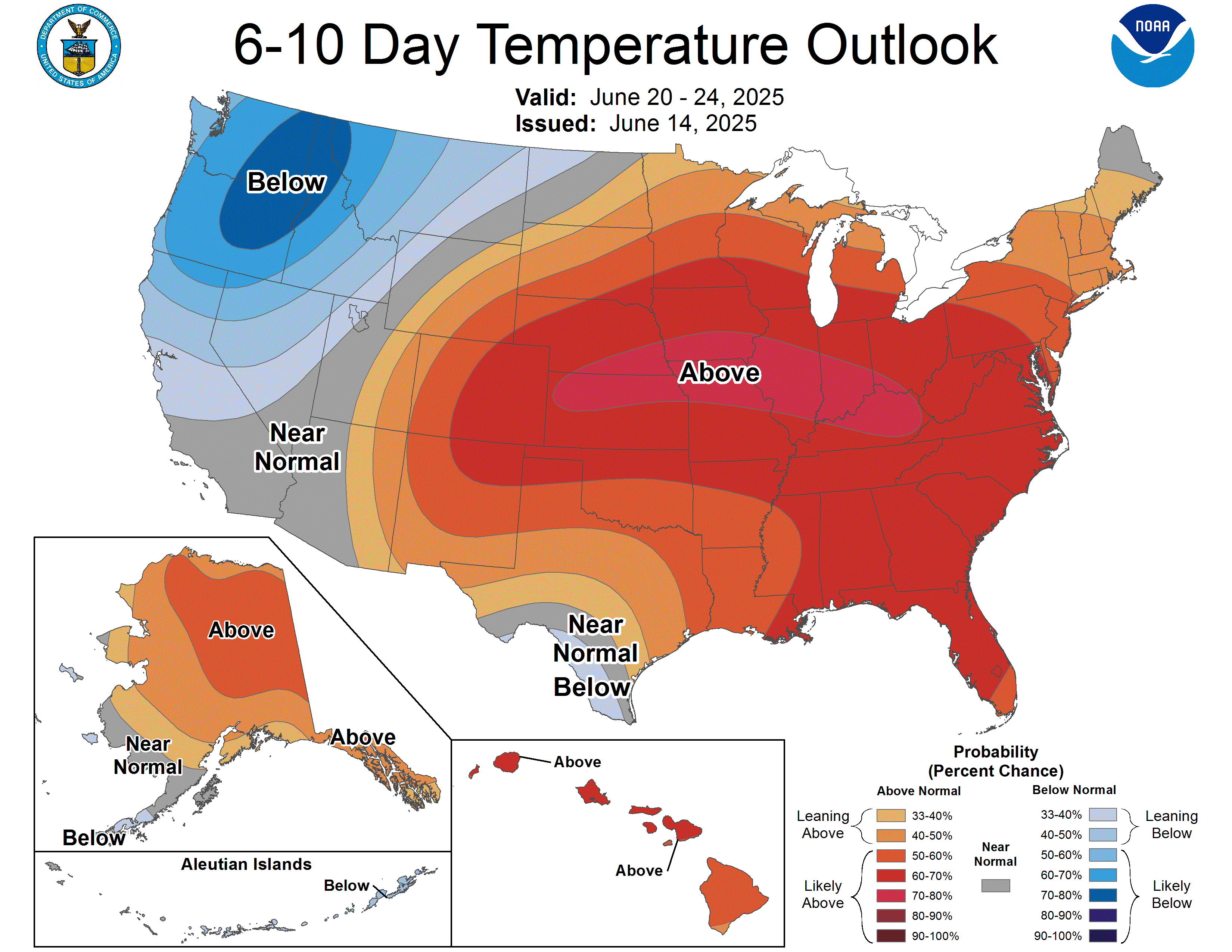
No comments:
Post a Comment